Portrait of Doge Alvise Mocenigo
Artist
Jacopo Tintoretto
Italian, 1519 - 1594
Dateca. 1570
Place of OriginVenice, Italy
MediumOil on canvas
DimensionsStretcher: 21 1/2 x 15 1/2 in. (54.6 x 39.4 cm)
Frame Dimensions: 30 3/8 x 24 5/8 in. (77.2 x 62.5 cm)
Frame Dimensions: 30 3/8 x 24 5/8 in. (77.2 x 62.5 cm)
ClassificationsPaintings
Credit LineThe Hyde Collection Trust, 1952
Object number1971.49
On View
On viewCollections
- European Paintings & Sculpture
MarkingsOn stretcher, paper label: "2018/Tintoretto/Portrait of a Venetian Senator".
In white chalk: "1B".
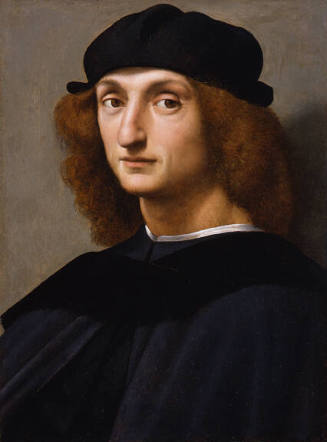
DescriptionAlvise Mocenigo (1507-1577) served as doge—the elected lifetime leader of the Republic of Venice—from 1570 to 1577, a particularly complicated time in Venetian history. On one hand, he ruled during the historic victory over the Ottoman Turks in the 1571 sea battle of Lepanto, but on the other he led during the disastrous plague of 1575-1577 and died in 1577 by committing suicide by hanging. The identification of the sitter here is based on the similarity of facial features to Tintoretto’s official "Portrait of Doge Mocenigo" in the Accademia, Venice, as well as to other known paintings of the Doge, for example, that in the National Gallery of Art in Washington, D.C. of ca. 1575, and in a ca. 1577 unfinished oil study at the Metropolitan Museum of Art in New York, both also by Tintoretto. Unlike in these later portraits, in The Hyde painting of ca. 1570, a dating based on style, he seems more youthful and less formal: his facial and head hair lack gray streaks, and the portrait is only bust length, while the others are full or three-quarters length. His dress is more informal than in official portraits of the doge; for instance, he lacks here the doge’s distinctive hat and cape. A bit of the collar of his chemise is visible from under his dark gown, and the gown is turned back to reveal its brown fur lining. The background is a neutral, almost black, color.
Possibly the Hyde portrait served as a study for the official portraits of the later 1570s. His upper body posture remains identical to theirs; like them, Mocenigo’s body is angled in a three-quarter view, while he slightly turns his head in order to confront the viewer directly. It is also possible The Hyde portrait predates his official reign as doge in 1570, thus explaining the absence of formal dress.
Text by Penny Howell Jolly, Professor Emerita of Art History, Skidmore College, February 2026Exhibition History"Family Pride: The Italian Renaissance House and its Furnishing", The Hyde Collection, Glens Falls, NY, April 12-May 20,1984.
"Growing Up in a Renaissance Palazzo: Childhood in Italy 1400-1600," Charles R. Wood Gallery, The Hyde Collection, Oct. 5, 2024-Jan. 5, 2025.Provenancebefore 1940, Ballochmyle House, Ayrshire, Scotland, Sir Claude Alexander
by 1943, New York, NY, Lilienfield Gallery
1943, Glens Falls, NY, Mrs. Charlotte P. Hyde
1952, Glens Falls, NY, The Hyde Collection Trust