
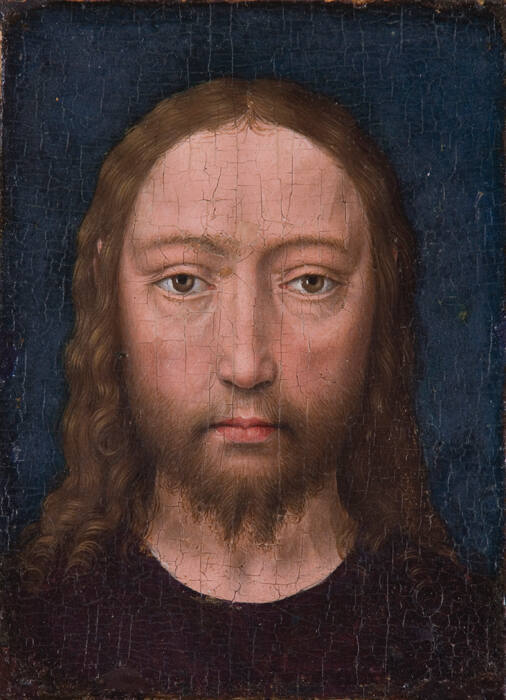
Head of Christ
Artist
Hans Memling, (School of)
Netherlandish, 1430 - 1494
Dateca. 1480
Place of OriginNetherlands
MediumOil on panel
DimensionsPanel: 4 13/16 x 3 9/16 in. (12.2 x 9 cm)
Frame Dimensions: 7 1/8 x 6 in. (18.1 x 15.2 cm)
Frame Dimensions: 7 1/8 x 6 in. (18.1 x 15.2 cm)
ClassificationsPaintings
Credit LineBequest of Charlotte Pruyn Hyde
Object number1971.1
On View
On viewCollections
- European Paintings & Sculpture
InscribedOn frame: "TRUX," "38", several other illegible inscriptions.
DescriptionIsolated in a frontal close-up, Christ makes direct eye contact with the viewer. His hair is neatly parted at the center, long ringlets hanging down onto his shoulders. His cleft beard is slight, and his head is silhouetted against a plain dark blue background. Besides his face, only his neck and the top parts of his shoulders are visible. There is no evidence of the panel having been cut down.Frontal portraits of Christ staring directly at the viewer were very popular devotional images in fifteenth-century Europe. Christ’s frontal face, considered by the faithful to be his true likeness, was believed to be copied from a veil with a magically imprinted image of Christ—the vera icon, also known as the vernicle or sudarium. According to fourteenth-century texts, it appeared when Saint Veronica, whose name reveals her role in this account of the vera icon, saw Christ struggling to carry his cross up Mount Golgotha prior to his crucifixion. She compassionately wiped his face with her veil. When she pulled it away, Christ’s true image appeared, one "not made by [human] hands" (an acheiropoieton).
By the twelfth century, the relic of Veronica’s veil was displayed at St. Peter’s in Rome, where pilgrims came to venerate it. Copies were made of the Holy Face and spread over Christendom, because it was believed that the power invested in the original veil relic was shared by all reproductions, from small pilgrim badges to illuminated manuscripts to large-scale frescoes. Even at St. Peter’s, when the original relic disappeared during the 1527 Sack of Rome, it was replaced by a powerful copy, which remains there today.
It is not absolutely clear what the original veil relic looked like, since even the earliest extant copies vary. Examples of inconsistencies include the presence of a simple gold halo, an elaborate cruciform halo, or no halo, or the addition of one hand raised in blessing. A number of examples show a longer view of his upper body, while others reveal only the neck and tops of the shoulders. Still others depict simply an isolated, "floating" head. Some include an alpha and omega on either side of Christ’s head or spell out REX REGNUM in jewels on the top edge of his garment; others emphasize connections to the Passion narrative by including a Crown of Thorns, with or without drops of blood.
The Hyde’s School of Memling "Head of Christ" derives from a now lost painting from 1438 by Jan van Eyck, known today through several copies (e.g., in Munich and in Berlin). A modern cleaning of The Hyde’s version removed a gold halo judged unoriginal, and revealed the dark blue background.
Text by Penny Howell Jolly, Professor Emerita of Art History, Skidmore College, February 2026Exhibition History"Medieval Art in Upstate New York", Everson Museum of Art, Syracuse, NY, 1974.
"Objects of Devotion", Hoopes Galllery, The Hyde Collection, Nov. 30, 2003- Feb. 29, 2004.ProvenanceMilch Gallieries, New York, New York, by 1930; purchased by Louis [1866-1934] and Charlotte [1867-1963] Hyde, Glens Falls, New York, 1930; by bequest to The Hyde Collection, Glens Falls, New York, 1952.




![Zanobi di Benedetto Strozzi (Italian [Florentine], 1412 - 1468), Sts. Nicholas, Lawrence and Jo…](/internal/media/dispatcher/115/thumbnail)