
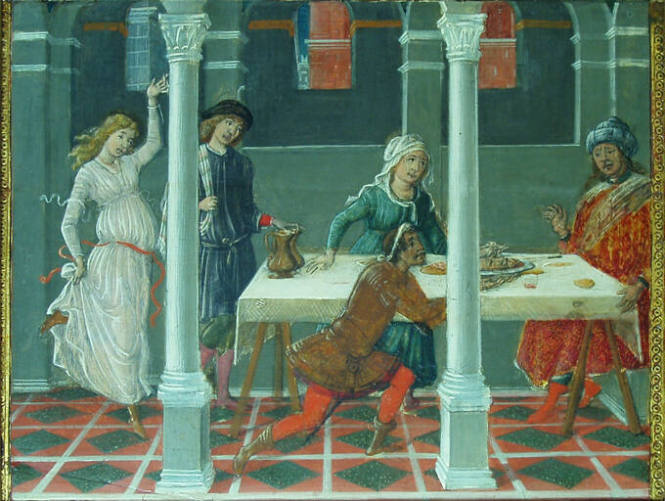
The Dance of Salome
Artist
Matteo di Giovanni
Italian, ca. 1430 - 1495
Dateca. 1485 - 1495
Place of BirthArezzo, Italy
Place of DeathSiena, Italy
MediumTempera and gold leaf on wood panel
DimensionsPanel: 10 3/4 × 14 3/8 in. (27.3 × 36.5 cm)
Frame Dimensions: 17 1/4 × 20 3/4 × 2 3/4 in. (43.8 × 52.7 × 7 cm)
Frame Dimensions: 17 1/4 × 20 3/4 × 2 3/4 in. (43.8 × 52.7 × 7 cm)
ClassificationsPaintings
Credit LineBequest of Charlotte Pruyn Hyde
Object number1971.28
On View
On viewCollections
DescriptionThe story of the feast of King Herod and the dance of Salome appears in the Gospels of both Matthew (14.3-12) and Mark (6.17-29). Following John the Baptist’s assertion that Herod’s marriage to Herodias, his brother’s wife, was unlawful, as proscribed in the Hebrew Torah, the king imprisoned him. Yet Herodias desired further revenge. Salome, Herodias’s daughter by Herod’s brother, danced at Herod’s birthday feast and so pleased him that he offered her anything she wished, even half his kingdom. Following the advice of her mother, Salome instead requested the head of John the Baptist. Horrified, Herod nonetheless complied and called for John’s head on a platter.- European Paintings & Sculpture
We see these figures as we read the image from left to right, the narrative following the movement of the participants towards the focus of their attention, King Herod’s reaction to the arrival of John’s head. At the far left, Salome dances, her bright white gown and flowing hair calling viewers’ attention to her seductive beauty. Hers is the only figure depicted totally unobscured. Partly covered by a column, a young serving man holds two pitchers while looking toward the king. Beyond him sits Herodias, who also gazes at Herod and leans toward him. Below her kneels the soldier of the guard who executed John and brought his head to the king on a platter. Similar to Donatello’s ca. 1425 gilded bronze relief of the same subject in the Siena baptistery, Herod pulls away from the head in disgust and fear, while Herodias eagerly reaches toward it with her left hand. Matteo uses one-point perspective to create a neat "box" of space for his narrative, yet locates his vanishing point—typically at a location the artist wishes viewers to focus on—in the window between Herodias and the young servant. Rather than directing viewers to a significant element in the story, the window view shows some simple architectural elements. This counter-movement to the narrative movement creates tension within the scene.
It appears Matteo’s painting originally served as a predella panel from a now dismembered and only partly extant altarpiece. Dóra Sallay reconstructs it as including images of standing Sts. Bernardino, John the Baptist, and Peter, above predella panels of "San Bernardino Restoring a Child to Life" (private collection), The Hyde’s "Banquet of Herod," a "Crucifixion of Christ" (Manchester Art Museum, Manchester), and the "Crucifixion of St. Peter" (Keresztény Muzeum, Esztergom). One predella panel remains missing, and the identity of the fourth standing saint is unknown. Sallay proposes the main central image represented the Madonna and Child.
Text by Penny Howell Jolly, Professor Emerita of Art History, Skidmore College, February 2026Exhibition History"Painting in Renaissance Siena: 1420- 1500", Metropolitan Museum of Art, New York, December 20, 1988- March 19, 1989.
"The Hyde Collection: IBM Gallery of Science and Art", IBM Gallery of Science and Art, New York, June 20- Aug. 26, 1989.
"Objects of Devotion", Hoopes Gallery, The Hyde Collection, Nov. 30, 2003- Feb. 29, 2004.
"Growing Up in a Renaissance Palazzo: Childhood in Italy 1400-1600," Charles R. Wood Gallery, The Hyde Collection, Oct. 5, 2024-Jan. 5, 2025.Provenanceby 1950, New York, NY, Lilienfeld Galleries
1950, Glens Falls, NY, Mrs. Charlotte P. Hyde
1963, Glens Falls, NY, The Hyde Collection Trust, (Bequest of Charlotte P. Hyde)
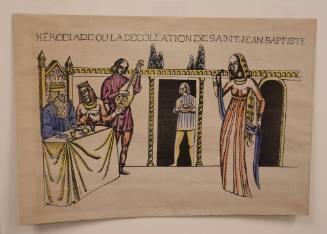
Emile Bernard
ca. 1894 - 1895

![Zanobi di Benedetto Strozzi (Italian [Florentine], 1412 - 1468), Sts. Nicholas, Lawrence and Jo…](/internal/media/dispatcher/115/thumbnail)



ca. 1215 - 1220

