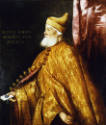
Portrait of Doge Petrus Lando
Artist
Titian, (Style of)
Italian, ca. 1488 - 1576
Dateca. 1545
Place of OriginVenice, Italy
MediumOil on canvas
DimensionsStretcher: 46 × 39 in. (116.8 × 99.1 cm)
Frame Dimensions: 61 × 54 × 4 in. (154.9 × 137.2 × 10.2 cm)
Frame Dimensions: 61 × 54 × 4 in. (154.9 × 137.2 × 10.2 cm)
ClassificationsPaintings
Credit LineThe Hyde Collection Trust, 1952
Object number1971.50
On View
On viewCollections
- European Paintings & Sculpture
InscribedInscribed UL: "PETRUS LANDO VENETIAR DVX MDXLV."
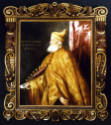
DescriptionThe inscription against the dark background of this painting both identifies the sitter as Petrus Lando (1462-1545), the Doge of the Republic of Venice from 1539 to 1545, and dates it to 1545, the year of his death. Possibly it was intended as a memorial. The Venetian doge—Venetian dialect for "duke" or "leader," from the Latin "dux"—was selected for lifetime rule via a complicated voting system by the members of the Great Council of Venice. Lando, depicted three-quarters length, as in many of Titian’s formal portraits, wears the official dress of the Venetian doges, including the highly distinctive hat (the corno ducale). He proffers a sealed document with his right hand while silhouetted partially in front of an opened curtain and partially in front of a neutral background. Angled to our left, and facing left almost in profile, he looks into the light and casts a shadow on the curtain.The elaborate Sansovino frame dates from the sixteenth century. So named in the nineteenth century after the style of the sculptor and architect Jacopo Sansovino, such frames were produced in sixteenth-century Venice and the Veneto. Typical of the style, The Hyde’s frame includes gilded garlands of fruit, architectural elements, and overlapping scroll forms, along with figures, in this case, isolated heads and two Black nudes. The production of independent, removable frames developed in the early 1500s.
Scholars agree the painter is not Titian himself but another, closely influenced by him. The awkwardness of the sitter’s left arm particularly suggests a weaker hand at work, as does the head, almost in profile rather than Titian’s typical three-quarter facial view.
Despite the inscription, the doge’s identity has been challenged, due to its close similarity to Titian’s ca. 1546/50 signed "Portrait of Doge Andrea Gritti" (National Gallery, Washington, D.C.).
Above text by Penny Howell Jolly, Professor Emerita of Art History, Skidmore College, February 2026
—
Venetian XVIth century carved & gilt walnut Sansovino-type frame
Text from 2013Exhibition History"Preserving the Legacy," Hoopes Gallery, The Hyde Collection, Mar. 31- May, 19, 1996.ProvenancePadua, Italy, Collection Senator Count Cittadella (according to Grassi; possibly Gino Cittadella Vigodarzere, Vill Soanara)
ca. 1913?, Florence, Italy, Luigi Grassi (dealer)
1932, Glens Falls, NY, Mr. and Mrs. Louis F. Hyde
1952, Glens Falls, NY, The Hyde Collection