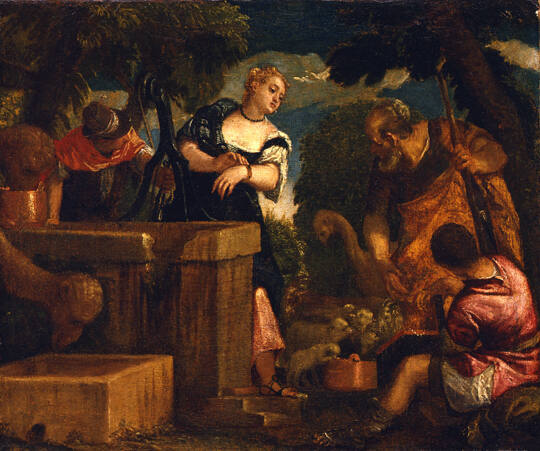
Rebecca at the Well
Artist
Paolo Veronese
Italian, 1528 - 1588
Dateca. 1570
Place of OriginVenice, Italy
MediumOil on canvas
DimensionsStretcher: 18 1/2 × 22 in. (47 × 55.9 cm)
Frame Dimensions: 28 1/8 × 31 3/4 in. (71.4 × 80.6 cm)
Frame Dimensions: 28 1/8 × 31 3/4 in. (71.4 × 80.6 cm)
ClassificationsPaintings
Credit LineThe Hyde Collection Trust, 1952
Object number1971.57
On View
On viewCollections
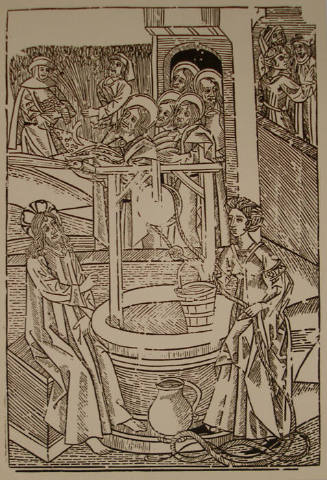
DescriptionDrawing on Genesis 24, Veronese depicts Rebecca’s selection as the wife for Abraham’s son Isaac, ascertained when she generously fetches well water for Abraham’s thirsty servant and waters his camels. The servant rewards her with golden earrings and bracelets, one of which she fingers while he directs her gaze into an open jewelry box. While Abraham does not participate in this section of the biblical narrative, possibly he is the white-haired figure standing at our right, the servant below him. A third man looks on from behind the well, sheep and one camel graze in the middle ground, and two camels at the left come to drink at the newly filled water trough. - European Paintings & Sculpture
Rebecca, "a most beautiful virgin" (Genesis 24:16), appears here as an ideal Renaissance beauty, her external physical appearance reflecting and expressing her interior virtuous nature. Blonde hair was sought after as the ideal color by sixteenth-century Renaissance women, as seen in many of Veronese’s portraits and other idealized paintings, and multiple recipes and devices claimed to bleach hair. Semitic Rebecca was unlikely a blonde, but Veronese pictures her here as a perfect, sixteenth-century bella.
Veronese, as his name implies, was trained in his native town of Verona, but moved to Venice, where he enjoyed a highly successful career alongside painters like Titian and Tintoretto. He commonly created large-scale works for public buildings and private dwellings. The small size of this painting suggests it may have been intended for a domestic setting.
Text by Penny Howell Jolly, Professor Emerita of Art History, Skidmore College, February 2026Exhibition HistoryMunson-Williams-Proctor Institute, Utica, New York, 1949.
"Objects of Devotion", Hoopes Gallery, The Hyde Collection, Nov. 30, 2003- Feb. 29, 2004.
"Hair: Untangling a Social History" The Tang Teaching Museum, Skidmore College, March 2 - June 21, 2004.
"Growing Up in a Renaissance Palazzo: Childhood in Italy 1400-1600," Charles R. Wood Gallery, The Hyde Collection, Oct. 5, 2024-Jan. 5, 2025.ProvenanceBefore 1789, France, Charles Alexandre Calonne
1795, London, England, Messrs. Skinner and Dyke (dealers)
by 1948, New York, NY, Lilienfeld Galleries
1948, Glens Falls, NY, Mrs. Charlotte P. Hyde
1952, Glens Falls, NY, The Hyde Collection Trust