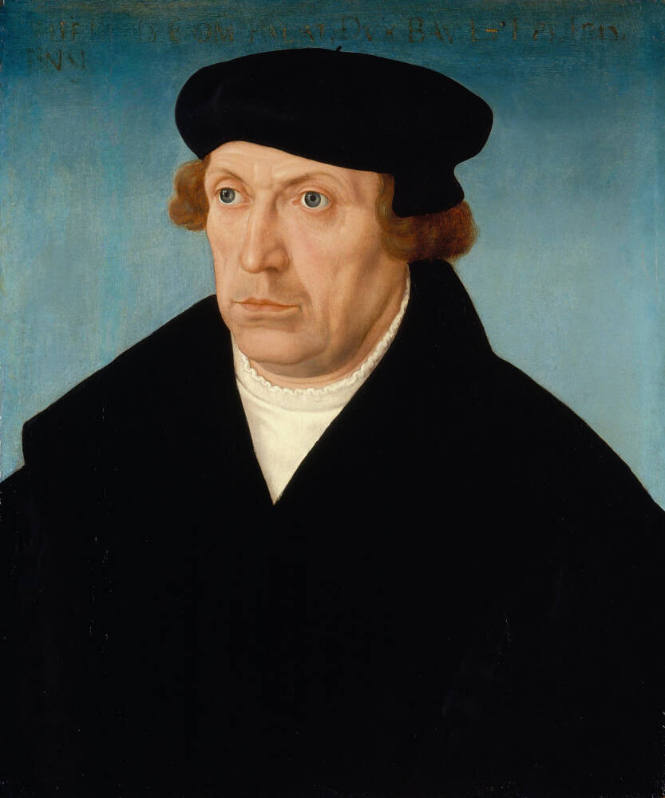
Portrait of Philipp von der Pfalz, Bishop of Freising
Artist
Barthel Beham
German, 1502 - 1540
Dateca. 1528
Place of OriginGermany
MediumOil on panel
DimensionsPanel: 17 × 14 in. (43.2 × 35.6 cm)
Frame Dimensions: 23 7/8 × 21 3/8 × 1 7/8 in. (60.6 × 54.3 × 4.8 cm)
Frame Dimensions: 23 7/8 × 21 3/8 × 1 7/8 in. (60.6 × 54.3 × 4.8 cm)
ClassificationsPaintings
Credit LineBequest of Charlotte Pruyn Hyde
Object number1971.7
On View
Not on viewCollections
- European Paintings & Sculpture
InscribedInscription on top of canvas reads: PHILLIPPVS COM PALAT DVX BAV EP FRI SINGENSIS.
DescriptionBarthel Beham, a well-known engraver as well as painter, became official painter to Duke Wilhelm IV in Munich in 1527, where he produced many court portraits. This likeness of Prince-Bishop Philipp von der Pfalz at about forty-eight years—identified by the inscription along the top of the painting—was executed not long after Beham’s arrival at court. Its style very much reflects an artist trained as an engraver, as we note its linear and meticulously detailed technique. Even though the sitter is a robust man with a large upper body, there is a flatness about the portrait, magnified by the neutral blue background. Prince-Bishop Philipp von der Pfalz (1480-1541) was a Catholic in Reformation Germany, though he was relatively tolerant of reformer Martin Luther. In late 1498, at age eighteen, he was appointed Bishop of Freising and in 1517 also became Bishop of Naumburg; he held these positions until his death. He wears here the type of hat typically worn by German bishops in less formal situations, a so-called "square cap" or pileus quadratus, a name that derives from its production from four pieces of cloth sewn together. First worn by bishops and priests, it became associated more generally with status, as seen in multiple portraits from the Tudor Court of Reformation England. Perhaps most famous are Hans Holbein’s portraits of Sir Thomas More and Erasmus. The flaps could be worn up or turned down for greater warmth, as seen here.
Text by Penny Howell Jolly, Professor Emerita of Art History, Skidmore College, February 2026ProvenanceParis, Madame Costanza
Duc D'Aumale
London, Laurie and Co.
1904, Dowdeswell & Dowdeswell
1904, New York, NY, American Art Association (auction)
1904, Collection of Joseph Pulitzer and Kate Davis Pulitzer
1929, New York, NY, American Art Association (auction)
by 1932, New York, NY, E. & A Milch Company (dealer)
1932, Glens Falls, NY, Mr. and Mrs. Louis F. Hyde
1963, Glens Falls, NY, The Hyde Collection Trust (Bequest of Charlotte P. Hyde)
![Zanobi di Benedetto Strozzi (Italian [Florentine], 1412 - 1468), Sts. Nicholas, Lawrence and Jo…](/internal/media/dispatcher/115/thumbnail)