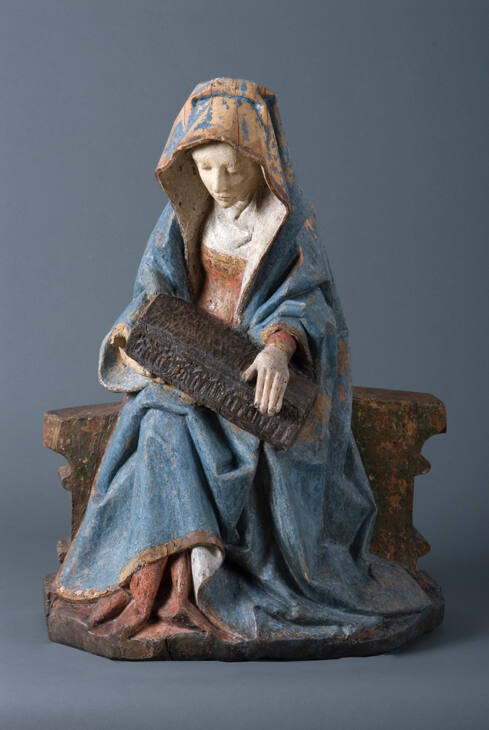
The Virgin Mary
Artist
Unknown
Dateca. 1485
Mediumwood, polychrome
DimensionsOverall: 30 x 21 1/2 x 11 in. (76.2 x 54.6 x 27.9 cm)
ClassificationsSculpture
Credit LineBequest of Charlotte Pruyn Hyde
Object number1971.90
On View
On viewCollections
DescriptionA female clothed in thick blue draperies covering her red gown sits on a curved wooden bench. The bench is constructed with pilaster-like forms at each end and was originally painted yellow-green. The figure sits with her head tilted down toward the large carved box she holds in her lap. Her mood seems pensive and perhaps melancholic. - Sculpture
- European Paintings & Sculpture
The identification of this figure is puzzling, though several possibilities have been proposed. James Kettlewell in "The Hyde Collection Catalogue" (1981) suggests the figure is of German origin and represents the Virgin Mary, and that her seated, melancholic posture with a box on her lap creates a "symbolic" Pietà, foreseeing her future sorrow. He notes the box resembles a sarcophagus and may represent a small altar, thus creating a reference to the entombed, dead Christ. He argues this imagery is part of a German iconographical tradition and supports a German origin.
Joan Holladay and Susan Ward dispute Kettlewell’s theory, believing there to be no reference to Christ in the sculpture. The authors instead propose the figure is a female saint or donor holding a portable altar, reliquary, or documents box, and was produced in the Brabant ca. 1500. They suggest a possible identification as Rizza of Koblenz, daughter of the ninth-century Frankish King and Holy Roman Emperor Louis the Pious, who was beatified in 1265 and sometimes appears with a casket or coffer. They do acknowledge that Rizza’s cult remained very local, with no sign of interest in her in Brabant. Alternatively, the figure could represent a donor, yet if so, they question why she would be so melancholic. They conclude the figure’s identity presents :a conundrum."
In 2025, Elizabeth Rice Mattison (Curator at the Hood Museum, Dartmouth College) suggested the figure could be the Virgin Mary holding a coffret, a box used while travelling to hold personal belongings or to function as a portable altar with religious prints typically attached to the inside lid. She proposes this is "Mary at the Rest on the Flight into Egypt" and identifies the place of origin as France, either Burgundy or Champagne. Sandra Hindman recently identified and highlighted the roles of such coffrets, in images made from the late fifteenth century through the eighteenth century. She also notes a painted "Rest on the Flight into Egypt" (Antwerp, ca. 1530) including what she believes to be the only extant contemporary depiction of such a coffret. Lying open on the ground near Mary’s feet, it reveals its contents: a Book of Hours, rosary, brush, scissors, and two rings resting on a cloth. The coffret appears to be of wood with metal reinforcements and a keyhole for locking, and also has attached carrying straps for travel.
All of these proposed identifications are problematic in some way. Kettlewell’s identification of the figure as the Virgin Mary is most likely, since she wears Mary’s typical red under gown and voluminous blue mantle. It also fits well the melancholic mood of the sculpture by recalling her posture at the Pietà. Yet the scene of Mary holding a symbolic box/coffin seems unique.
Holladay and Ward suggest the figure could be a donor, but her pose is unusual for that role: so contemplative rather than outward focused. Her red and blue dress is also that commonly worn by the Virgin Mary. What other saint or holy figure this could be is uncertain. As noted above, Rizza’s cult is very local and centered in Koblenz, not the Netherlands or northern France, and so is an unlikely identification.
Mattison’s most recent identification, as "Mary at the Rest on the Flight into Egypt," is perhaps the most convincing, yet is also most problematic. In The Hyde’s sculpture, Mary sits on a bench, one made by human hands, though no such carpentered furniture appears with Mary and Joseph as they flee on a donkey into Egypt. By contrast, in contemporary narratives of this scene, Mary sits out in nature, on a grassy knoll or the ground, with a travelling basket and sometimes a canteen nearby. The Hyde’s Mary expresses sorrow, not typically seen in such scenes, and the absence of Christ remains unexplained. Scenes of her at rest by painters of the period (by Gerard David, Joachim Patinir, and others in Bruges and Antwerp) consistently show the Virgin holding Christ, often offering him sustenance: commonly he eats grapes, a reference to his future bloodshed, sometimes an apple in reference to Adam and Eve, or he nurses at the Virgin’s breast. Finally, The Hyde’s box itself lacks key features of travelling coffrets, such as a keyhole and straps. The identification of the figure remains uncertain.
Text by Penny Howell Jolly, Professor Emerita of Art History, Skidmore College, February 2026Exhibition History"Preserving the Legacy," Hoopes Gallery, The Hyde Collection, Mar. 31- May, 19, 1996.
"Objects of Devotion," Hoopes Gallery, The Hyde Collection, Nov. 30, 2003- Feb. 29, 2004.ProvenanceNew York, NY, Brummer Gallery, Inc.,
Glens Falls, NY, Mr. and Mrs. Louis F. Hyde
1963, Glens Falls, NY; The Hyde Collection Trust (Bequest of Mrs. Charlotte P. Hyde)
![Zanobi di Benedetto Strozzi (Italian [Florentine], 1412 - 1468), Sts. Nicholas, Lawrence and Jo…](/internal/media/dispatcher/115/thumbnail)

ca. 1215 - 1220