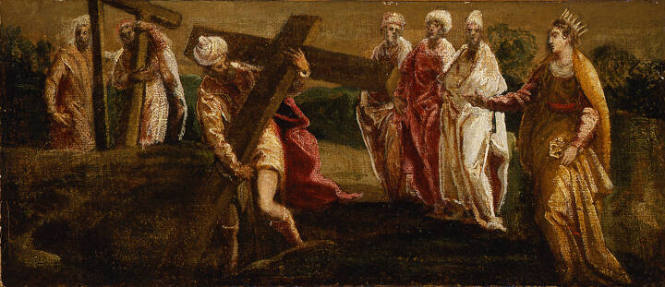
The Discovery of the True Cross
Artist
Jacopo Tintoretto
Italian, 1519 - 1594
Dateca. 1550 - 1555
Place of OriginVenice, Italy
MediumOil on canvas
DimensionsStretcher: 19 1/8 × 20 3/4 in. (48.6 × 52.7 cm)
Frame Dimensions: 12 1/2 in. (31.8 cm)
Frame Dimensions: 12 1/2 in. (31.8 cm)
ClassificationsPaintings
Credit LineThe Hyde Collection Trust, 1952
Object number1971.48
On View
On viewCollections
DescriptionSt. Helena was a particularly popular saint in Venice, the city where Tintoretto worked. Mother of the Roman Emperor Constantine, the man who legalized all religions in his Empire, including Christianity, Helena made a pilgrimage in 326-28 to the Holy Land. According to Jacopo da Voragine’s Golden Legend, a Jew revealed to her the burial site of the three crosses used to crucify Christ and the two thieves. Helena stands here at the far right and makes a commanding speech gesture towards the turbaned man unearthing the third of the three crosses, seen at the left. His Jewish "otherness" is revealed through his turban and his unseemly bare legs.- European Paintings & Sculpture
This painting formed the middle episode of three recording Helena’s legend, each depicted on a small canvas by Tintoretto: the "Embarkation of St. Helena for the Holy Land" (Victoria and Albert Museum in London), The Hyde’s "Discovery," and the "Identification of the True Cross" (Art Institute of Chicago). This last episode reveals which of the three is Christ’s cross when each in turn is laid upon a dead man. Only when touched by the true cross, did the corpse return to life. Small splinters of the true cross were enormously popular as relics throughout Europe.
Former Hyde curator James Kettlewell proposed these three paintings originally formed the predella for an altarpiece dedicated to St. Helena, today in the Brera Picture Gallery, Milan. But based on their sketchy style and low vanishing points, scholar Ana Debenedetti has proposed they functioned as part of a documented decorative cycle devoted to St. Helena on a wall in the Common Room at St. Marcuola in Venice and dates them to the first half of the 1550s.
Text by Penny Howell Jolly, Professor Emerita of Art History, Skidmore College, February 2026Exhibition HistoryKaiser Friedrich Museum, Berlin, July- Aug. 1935, no. 399a.ProvenanceLondon, England, Thomas Andros de la Rue, Bart.
London, England, R. Langton Douglas
New York, NY, Philip Lydig (?)
New York, NY, Rita Lidig (by inheritance)
1913, New York, NY, American Art Association (auction)
by 1931, Berlin, Germany, Hess Collection
1931, Berlin Germany, Hess Collection auction
Munich, Germany, Julius Boehler
by 1940, Glens Falls, NY, Mrs. Charlotte P. Hyde
1952, Glens Falls, NY, The Hyde Collection Trust


![Zanobi di Benedetto Strozzi (Italian [Florentine], 1412 - 1468), Sts. Nicholas, Lawrence and Jo…](/internal/media/dispatcher/115/thumbnail)

![Jesus Teaches in the Temple (plate 54 of the first edition of "Evangelicae Historiae Imagines, Adnotationes et Meditationes in Evangelia" [Illustrations of the Gospel Stories, Notes and Meditations on the Gospels])](/internal/media/dispatcher/1458/thumbnail)