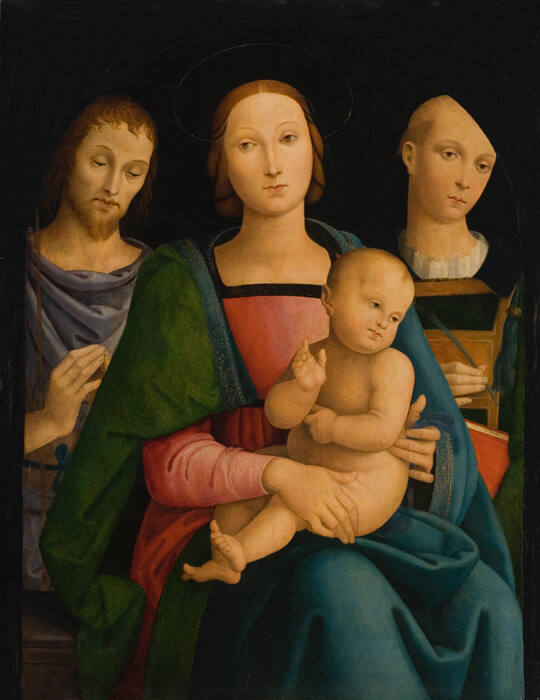
Madonna with Two Saints
Artist
Perugino, (Style of)
Italian, 1450 - 1523
Dateca. 1494
Place of OriginPerugia, Umbria, Italy
MediumOil/tempera on panel
DimensionsPanel: 30 3/4 × 23 3/4 in. (78.1 × 60.3 cm)
Frame Dimensions: 33 1/2 × 26 in. (85.1 × 66 cm)
Frame Dimensions: 33 1/2 × 26 in. (85.1 × 66 cm)
ClassificationsPaintings
Credit LineThe Hyde Collection Trust, 1952
Object number1971.32
On View
On viewCollections
DescriptionThe sweet style of Pietro Perugino, the teacher of Raphael, is immediately evident. The Hyde’s painting is one of a series of closely related works by Perugino and his followers, all depicting Mary and Christ with two saints, from ca. 1493-95; it must have been a popular composition, especially because it easily allowed for variations for different patrons. For example, two variants by Perugino, both in rectangular format and located today in the Kunsthistorisches Museum, Vienna and the Louvre in Paris, share the same cartoon (Perugino’s full-scale preparatory drawing), but vary certain elements. The Vienna painting, a signed work of ca. 1493-95 by Perugino, sets the four figures against a blue sky and surrounds the Madonna and Christ with Sts. Rosa and Catherine. By contrast, the Paris version, ca. 1495, sets its figures against a black background and substitutes John the Baptist at the left for Vienna’s Rosa.- European Paintings & Sculpture
The Hyde’s variant, also dated ca. 1493-95, replaces St. Catherine at the right with a tonsured male saint, likely St. Lawrence. Even though he lacks his primary attribute of the grill on which he was martyred, his identity here is based on his similarity to other images of the saint by Perugino and contemporaries; see, for example, Perugino’s Decemviri Altarpiece of 1495-96 (Pinacoteca Vaticana, Rome) and the ca. 1496-1520 "Study for the Head of St. Lawrence" by a follower of Perugino (Morgan Library and Museum, New York). In multiple images, including The Hyde panel, he holds a small, pen-like martyr’s palm and book, and dresses in a dalmatic, the ecclesiastical dress of a deacon, having been ordained as such by Pope Sixtus in 257.
Unlike the Vienna and Paris examples, The Hyde’s "Style of Perugino" painting has extensive overpainting, complicating the attribution, and it remains uncertain whether it originally had been arch-shaped at the top (as we see it now) or rectangular. In 1991, conservation revealed that the image was probably transferred from its original panel to the present one; the painting may initially have been arched. All three paintings repeat identical hand gestures, head tilts, and body postures for their four figures. Perugino relied extensively on the use of cartoons in his shop for repeating elements and whole compositions.
The somber mood of the Virgin and saints suggests a reference to Christ’s future Passion. We see that particularly in the prominence of Mary’s red gown in this otherwise rather dark composition, and Christ’s left hand touching where he will suffer his future side wound.
Text by Penny Howell Jolly, Professor Emerita of Art History, Skidmore College, February 2026Exhibition History"Masterpieces of Art", New York, World's Fair, New York, May- Oct. 1939.
"Growing Up in a Renaissance Palazzo: Childhood in Italy 1400-1600," Charles R. Wood Gallery, The Hyde Collection, Oct. 5, 2024-Jan. 5, 2025.ProvenanceItaly, Perugia, a noble family
Italy, Carpi, a Museum
before 1939, New York, NY, Jacob M. Heimann (dealer), (by exchange)
1939, Glens Falls, NY, Mrs. Charlotte P. Hyde
1952, The Hyde Collection Trust
![Zanobi di Benedetto Strozzi (Italian [Florentine], 1412 - 1468), Sts. Nicholas, Lawrence and Jo…](/internal/media/dispatcher/115/thumbnail)




ca. 1215 - 1220