Equestrian Crucifixion
Artist
Unknown
Dateca. 1350
Place of OriginSiena, Tuscany, Italy
MediumTempera and gold leaf on panel
DimensionsOverall: 23 1/8 x 11 in. (58.7 x 27.9 cm)
Frame Dimensions: 29 7/8 x 14 1/8 x 1 1/2 in. (75.9 x 35.9 x 3.8 cm)
Frame Dimensions: 29 7/8 x 14 1/8 x 1 1/2 in. (75.9 x 35.9 x 3.8 cm)
ClassificationsPaintings
Credit LineBequest of Charlotte Pruyn Hyde
Object number1971.4
On View
On viewCollections
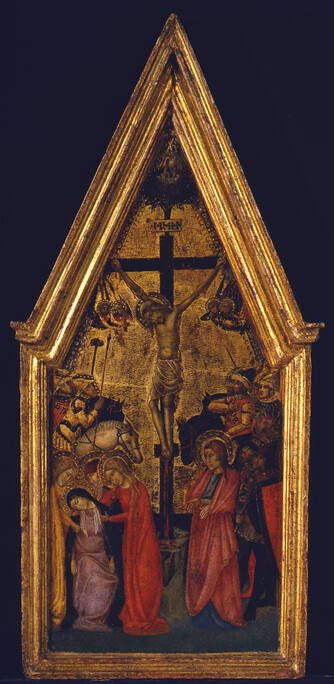
DescriptionThe unidentified artist creates a rather crowded scene. Central to the event, a haloed Christ wears the crown of thorns and a transparent loin cloth, thus appearing almost naked on the cross. Only three nails support his body: two for his hands and one for his feet. Blood drips down his face, arms, and feet, and spurts from his side wound. This type of the suffering Christ—the Christus patiens—depicts a dead or close-to-death Christ, his head slumped to one side with eyes closed and his body weight pulling on his extended arms in a slight S-curve. - European Paintings & Sculpture
At the lower left we see the swooning Virgin Mary—a common motif in Sienese crucifixions—dressed in a dark blue outer robe and consoled by Mary Magdalene, Mary Salome, and Mary Cleophas, all haloed. Unusually, the Magdalene lacks her most common attribute, an ointment jar, but is identified via her attributes of long, uncovered hair and red garments. Opposite them, in dark lavender and haloed, is John the Evangelist.
Above these haloed figures appear Christ’s detractors. To our left, Longinus rides a white horse while holding the lance he uses to pierce Christ’s body on his right side: salvific water and blood gush from the wound. Longinus appears with a hexagonal halo indicating his special significance, not as a saint or beatus, but as a virtuous man: a drop from Christ’s wound hits his eye and he immediately converts. Behind him, also mounted on a horse, is Stephaton holding a rod with the sponge dipped in vinegar, given to Christ in mockery when he was thirsty. To our right side a mounted Roman soldier, marked with [SP]QR on his chest, apparently also experiences conversion, as indicated by his arm gesture of acceptance and his hexagonal halo. The sign inscribed INRI above the Cross refers to the Latin phrase "Iesus Nazarenus Rex Iudaeorum" ("Jesus of Nazareth, King of the Jews"), written and ordered to be placed on the cross by Pontius Pilate, the Roman governor of Judea, as a mocking gesture (John 19.19).
Above, to either side of the Cross, fly pairs of praying angels, while above them, in the top pinnacle, a pious pelican nests with her young, piercing her breast with her beak to feed them. Like Christ, whom she symbolizes, she sheds her own blood to offer salvation to others. The tree that sprouts from the cross’ top anticipates the rebirth that shall result from Christ’s willing death. A gold leaf background—of actual gold hammered into thin sheets and then attached by bole to the panel and punched with decorative patterns—raises this earthly event to one of heavenly import.
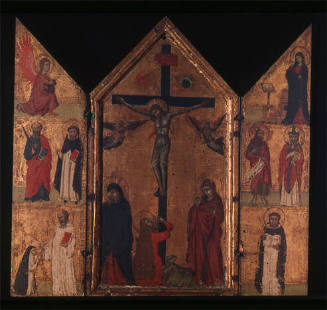
While it is tempting to suggest this small Crucifixion originally formed part of a larger whole, such as a diptych or triptych (compare for example The Hyde’s ca. 1325 triptych attributed to the Master of Monte Oliveto, 1971.5), its gabled frame reveals no hint of hinges or other markings of attachment to an additional element. Importantly, the applied gesso and gilding on the frame overlap onto the panel itself, confirming this to be its original frame. There is extensive repainting present, especially along the bottom.
The style and pictorial motifs clearly link this Crucifixion to the Sienese art of Duccio and Ambrogio and Pietro Lorenzetti. A similar panel by Ambrogio hangs in the Harvard Art Museums. Mojmír Frinta in 1974 attributed The Hyde "Crucifixion" to Guido Palmerucci of Gubbio (1280-ca. 1349) on the basis of both style and his use of punches inherited from the Lorenzetti studio, but little is known of him. The attribution of this painting remains uncertain. The small scale of the work suggests it was used for private, domestic devotions.
Text by Penny Howell Jolly, Professor Emerita of Art History, Skidmore College, February 2026Exhibition History"Medieval Art in Upstate New York," Everson Museum of Art, Syracuse, NY, 1974.
"Objects of Devotion", Hoopes Galllery, The Hyde Collection, Glens Falls, NY, Nov. 30, 2003- Feb. 29, 2004.ProvenanceCollection of B. Anthon [1], New York, NY; purchased by Louis [1866-1934] and Charlotte [1867-1963] Hyde, Glens Falls, New York, 1939; by bequest to the Hyde Collection, 1952.
[1] Letter from W.R. Valentiner to Mrs. Hyde, ca. 1933, mentions B. Anthon as a painter located in Detroit. Unclear if this is the same person.

ca. 1215 - 1220