Christ with Arms Folded
Artist
Rembrandt van Rijn
Dutch, 1606 - 1669
Dateca. 1657 - 1661
Place of OriginNetherlands
MediumOil on canvas
DimensionsStretcher: 43 × 35 1/2 in. (109.2 × 90.2 cm)
Frame Dimensions: 53 × 45 3/4 × 5 in. (134.6 × 116.2 × 12.7 cm)
Frame Dimensions: 53 × 45 3/4 × 5 in. (134.6 × 116.2 × 12.7 cm)
ClassificationsPaintings
Credit LineThe Hyde Collection Trust, 1952
Object number1971.37
On View
On viewCollections
DescriptionRembrandt has portrayed a remarkably vulnerable and human Christ. Set against a dark brown, almost black background only partially illuminated at the right where hints of architectural forms are visible, a somber young Christ, with dark beard and long hair curling over his shoulders, crosses his arms over his chest. Unseen light sources highlight his face, left hand, and the tip of his right thumb, which peeks above his left sleeve. He tips his head to his right while looking out solemnly towards the viewer, yet his thoughts seem interior, not focused on us. X-rays show his left arm originally reached down towards his lower left side. Rembrandt’s alteration showing crossed arms may allude to the Virgin Mary’s gesture of acceptance of the Holy Spirit at the Annunciation. Here Christ possibly also accepts his fate, his forthcoming Passion, perhaps also suggested by his well-lit left hand, protectively cradling the site of his future side wound. - European Paintings & Sculpture
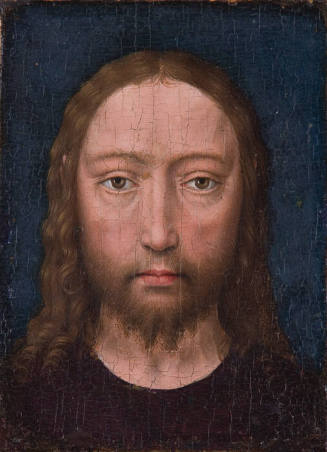
Rembrandt’s vision of Christ’s face differs from the well-established, traditional images produced by Medieval and Renaissance artists, in which an impassive Christ stares frontally. Characteristically his forehead is high and his beard small, and he displays an otherworldly expression; his divinity is confirmed by a halo encircling his symmetrical head. Found throughout the Western and Byzantine worlds, such traditional images were based on miraculously produced relics such as Veronica’s veil and the Mandylion of Edessa, both contact relics “not made by human hand” (acheiropoieta), or on the written description in the widely-known Publius Lentulus letter, purported to be written by a contemporary of Christ.
For his re-envisioning of Christ, Rembrandt instead turned to Amsterdam’s Jewish neighborhood and found a young Jewish man to serve as his live model. He has never been identified. Beginning about 1648 and continuing into the mid-1650s, using this model he produced a series of small oil sketches on wood panel of Christ’s head (at least seven are extant). These served as new, naturalistic models for Rembrandt’s late period religious art, including The Hyde’s monumental oil on canvas, “Christ with Arms Folded.” Expanded to half-length, Christ appears quietly meditative, with a low forehead and heavy brows, a dark moustache and beard, abundant head hair, and most unusually, no halo. Rembrandt has transformed him into a human god.
Rembrandt’s relationship with Amsterdam’s Jewish community is unclear, as is his personal religion. The city’s largely Protestant community tolerated diversity; Rembrandt’s father belonged to the Dutch Reformed Church, while his mother was Catholic. Rembrandt himself seems to have no record of participation in a church community. He certainly had commerce with Amsterdam’s Jews. Rembrandt not only used Jews as models, but Jews were among his patrons; documents confirm they commissioned portraits as well as book illustrations from him. Christian images of Christ’s head, however, seemed especially important to Rembrandt. A 1656 inventory of his house possessions revealed he kept three paintings of Christ’s head: two were in his bedroom and one very specifically was noted as being painted “from life.”
The Hyde’s canvas has been damaged. In 1915 it was stolen from Moscow’s Pushkin Museum and cut from its rectangular format into an oval shape. Following recovery in 1931, the oval was reunited in 1933 with its original canvas border, including narrow strips on all four sides that an unknown person used to expand it prior to its theft. Following repair, it was purchased by the Hydes.
While many works today labelled as Rembrandt’s were actually produced in his shop or by followers, The Hyde’s painting is accepted as “autograph” by virtually all scholars.
Text by Penny Howell Jolly, Professor Emerita of Art History, Skidmore College, October 2026Exhibition HistoryThe Austrian Museum, Vienna, 1873.
Palais du Corps Legislatif, Paris, 1874.
Museum of Fine Arts, Moscow, ca. 1930.
"Catalogue of European Paintings and Sculpture from 1300-1800, Masterpieces of Art, New York World's Fair", New York World's Fair,1939.
"Paintings by the Great Dutch Masters of the Seventeenth Century," Duveen Galleries, New York, October 8 - November 7, 1942.
"Five Centuries of Dutch Art," Art Association of Montreal, Montreal, Canada, March 9 - April 9, 1944.
"Rembrandt Paintings and Etchings," Fogg Museum of Art, Harvard University, Cambridge, MA, October 19 - November 27, 1948.
"Rembrandt's Christ in Thirteen Paintings and One Etching," The Hyde Collection, Glens Falls, NY, 1968.
"Rembrandt's Late Religious Portraits," National Gallery of Art, Washington DC, January 30 - May 1, 2005; J. Paul Getty Museum, Los Angeles, CA, June 7- August 28, 2005.
"Rembrandt and the Face of Jesus," Musee du Louvre, April 18 - July 18, 2011; Philadelphia Museum of Art, July 28 - Oct. 30, 2011; Detroit Institute of Arts, Nov. 20, 2011 - Feb. 12, 2012.
ProvenanceRome, Italy, Collection of Cardinal Joseph Fesch (1763 – 1839)
1845, Rome, Italy, Palais Ricci auction
until 1873, Paris, France, De Forcade
Paris, France, Collection of Charles Sedelmeyer (1837 – 1925)
ca. 1900, St. Peterburg, Russia, Count Alexander Orloff Davidoff (Anatoly Orlov-Davydov)
1918, Petrograd, Russia, the Soviet State (nationalized)
by 1927, Moscow, Russia, Pushkin State Museum
1933, Berlin, Germany, sale through Van Dieman Galleries
1933, Glens Falls, NY, Mr. and Mrs. Louis F. Hyde
1952, Glens Falls, NY, The Hyde Collection Trust