

Madonna of the Lilies
Artist
Luca della Robbia
Italian, 1399/1400 - 1482
Dateca. 1450 - 1460
Place of OriginItaly
MediumTerracotta with tin-glaze
DimensionsPanel: 20 1/4 × 16 1/8 in. (51.4 × 41 cm)
Frame Dimensions: 29 1/2 × 19 1/4 × 4 1/2 in. (74.9 × 48.9 × 11.4 cm)
Frame Dimensions: 29 1/2 × 19 1/4 × 4 1/2 in. (74.9 × 48.9 × 11.4 cm)
ClassificationsSculpture
Credit LineThe Hyde Collection Trust, 1952
Object number1971.99
On View
On viewCollections
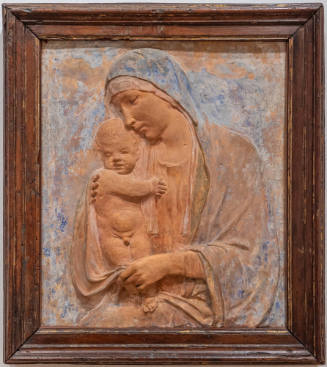
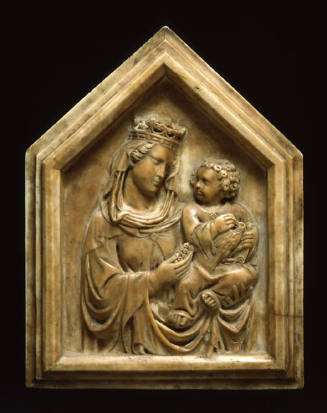
DescriptionThe Virgin Mary sits in profile on a cushion resting on grassy ground and holds a nude infant Christ on her lap. Christ turns from Mary and, with a very human, baby-like gesture, reaches out with both hands to our right, grabbing one of the three stalks of lilies reaching up from the ground. With the exception of some now mostly-lost painted facial detailing and gilding on haloes, cushion, and lilies (paint and gilding were added after firing), their bodies remain pure white, common in Luca della Robbia’s glazed terracotta style. Similarly, the pure blue background and greens and yellows of the flower stalks and grass, created with the use of tin glazes, are characteristic colors found in his other works. Luca invented and popularized this technique of glazed terracotta in the 1440s, and his descendants and workshop guarded its recipe well into the sixteenth century. The frame is the original; the painted shield at the frame’s bottom has not been identified.- Sculpture
- European Paintings & Sculpture
Luca did sometimes use molds to reproduce popular images like this one. Although there are multiple nearly identical versions of this relief of Mary and Christ with lilies, the presence of unique detailing of each confirms they are all hand-produced variants on Luca’s "Rovezzano Madonna" (see, for example, the variant example in the collection of the National Gallery in Washington, D.C.). The particularly high quality of The Hyde’s version has been noted by scholars, as has the survival of its original tabernacle frame.
This type of image with Mary seated on the lowly ground is called the Madonna of Humility. Christ similarly downplays his divinity by appearing as a fully nude and vulnerable human baby. Indeed, his positioning across Mary’s lap and nudity recall representations of the Pietà, when Mary supports Christ’s crucified, dead body across her knees, thus again affirming Christ’s full humanity. The white lilies, a long-standing attribute of Mary common in Annunciation scenes, symbolize her purity and chastity; the three stalks could refer to the trinity, completed by Christ, or attest to medieval theologians’ widespread claim that Mary was a virgin before, during, and after Christ’s birth. Lilies were also the emblem of Florence, where Luca lived and worked.
Luca della Robbia’s glazed terracottas were enormously popular in both domestic and ecclesiastical settings. The small size of this terracotta suggests it may have been a domestic devotional image. Pleasant smells played a large role in Renaissance homes and devotion. Bad odors were associated with evil—with devils, sin, and the plague—while food smells were believed nourishing, and delicious perfumes and incense represented sanctity and were believed therapeutic. Thus aromatic candles, spices, and sweet smells were used during domestic meditation and prayers. Here, as Christ reaches out to lilies, we imagine inhaling their delicious fragrance and identify with these holy figures. The verdant ground hints at a bucolic garden setting, another location for heavenly meditation and sweet smells.
Text by Penny Howell Jolly, Professor Emerita of Art History, Skidmore College, February 2026Exhibition HistoryKaiser Freidrich Museum Verein, Berlin, May 1914, no. 208.
"Eighteenth Loan Exhibition of Old Masters: Italian Gothic and Early Renaissance Sculpture", Detroit Institute of Arts, Detroit, Jan. 7 - Feb. 20, 1938, no. 32.
"Masterpieces of Art", New York World's Fair, New York, 1939, no. 19, Gallery 2.
"Italian Renaissance Sculpture in the Time of Donatello", Detroit Institute of Arts, Detroit, MI, Oct. 21 - Jan. 5, 1985, Kimball Art Museum, Fort Worth, TX, Feb. 24 - Apr. 27, 1985.
"Objects of Devotion", Hoopes Gallery, The Hyde Collection, Glens Falls, Nov. 30, 2003- Feb. 29, 2004.
"Family Pride: The Italian Renaissance House and its Furnishing", The Hyde Collection, Glens Falls, NY, April 12-May 20, 1984.
"Growing Up in a Renaissance Palazzo: Childhood in Italy 1400-1600," Charles R. Wood Gallery, The Hyde Collection, Oct. 5, 2024-Jan. 5, 2025.Provenanceby 1929, Berlin, Germany, Dr. Edward Simon
by 1937, New York, NY, Paul Drey Galleries
1937, Glens Falls, NY, Mr. and Mrs. Louis F. Hyde
1952, Glens Falls, NY, The Hyde Collection Trust


![Zanobi di Benedetto Strozzi (Italian [Florentine], 1412 - 1468), Sts. Nicholas, Lawrence and Jo…](/internal/media/dispatcher/115/thumbnail)



ca. 1215 - 1220