Virgin Mary
Artist
Andrea della Robbia
Italian, 1435 - 1525 or 1528
Dateca. 1480
Place of OriginItaly
MediumGlazed terracotta, probably tin-glaze
DimensionsOverall: 31 1/4 × 12 3/4 × 7 in. (79.4 × 32.4 × 17.8 cm)
Other (Wall Niche): 58 1/4 × 31 1/2 × 7 in. (148 × 80 × 17.8 cm)
Other (Wall Niche): 58 1/4 × 31 1/2 × 7 in. (148 × 80 × 17.8 cm)
ClassificationsSculpture
Credit LineThe Hyde Collection Trust, 1952
Object number1971.98
On View
On viewCollections
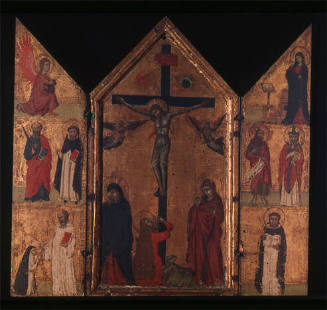
DescriptionAndrea della Robbia, the nephew of the more famous Luca della Robbia (see 1971.99), inherited his Florentine sculpture workshop upon his uncle’s death in 1482. It remained in family hands into the sixteenth century (The Hyde also owns works by Andrea’s son, Giovanni della Robbia, 1971.217.1, 1971.217.2, and 1984.3). Like his uncle, Andrea produced glazed terracottas, a technique Luca developed in the 1440s that was famous for its dominantly white and blue surfaces. Andrea, by contrast, often worked on a larger scale and commonly used more polychromy, as visible here in facial detailing, the halo, and landscape ground (at lower left). Nonetheless, it can be difficult to separate the work of the two artists. - Sculpture
- European Paintings & Sculpture
Mary is only one figure from what would have been a multi-figured scene of the Adoration of Christ. Its relatively large size suggests it was probably from an altarpiece, although scholar Rachel Boyd has suggested the unusual curve of the lower legs may reflect an original location in a tondo (circular) form. The figure here is not a fragment; indeed it was fired in a single piece and would have been combined with additional, separately fired figures.
Numerous related examples of Christ’s adoration made by Andrea and his shop exist in major museums across the United States and Europe, thus providing a variety of possible reconstructions for The Hyde’s original composition. Certainly the infant Christ originally lay on the ground adjacent to Mary; typically he appears nude, emphasizing his true humanity, while Mary kneeling and adoring him acknowledges his divinity. A blue sky, perhaps with a white dove, would have appeared behind them; a small triangular piece of soft blue-green earth, visible below her knees at the far left, confirms the original presence of a landscape, perhaps one with white lilies. As in a number of variants, garlands of luxuriant fruits and flowers may have framed the entire composition, and angels possibly crowded around her in the sky above her head. Some examples include Joseph kneeling opposite Mary and adoring Christ, and in some, God the father appears in the sky, acknowledging his son. The wide-spread popularity of these closely related yet individualized scenes in fifteenth-century Florence is evidenced by the numerous versions extant today.
Text by Penny Howell Jolly, Professor Emerita of Art History, Skidmore College, February 2026Exhibition History"Masterpieces Under the MIcroscope", Whitney-Renz Gallery, The Hyde Collection, Glens Falls, July 2, 2019-September 15, 2019Provenancebefore 1936, New York, NY, Brummer Gallery, Inc.,
1936, Glens Falls, NY, Mrs. Charlotte P. Hyde
1952, Glens Falls, NY, The Hyde Collection Trust
![Zanobi di Benedetto Strozzi (Italian [Florentine], 1412 - 1468), Sts. Nicholas, Lawrence and Jo…](/internal/media/dispatcher/115/thumbnail)

ca. 1215 - 1220