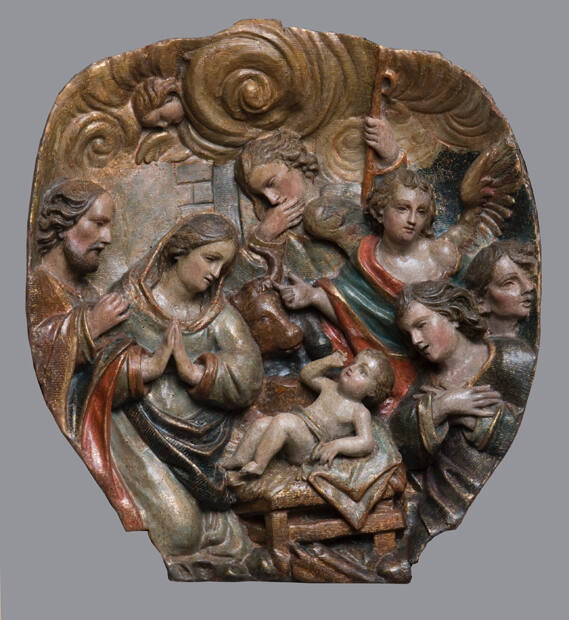
Adoration of the Christ Child (Nativity)
Artist
Unknown
Dateca. 1650
Place of OriginSpain
MediumWood and polychrome with gold leaf
DimensionsOverall: 22 1/2 x 20 1/2 x 3 1/2 in. (57.2 x 52.1 x 8.9 cm)
ClassificationsSculpture
Credit LineBequest of Charlotte Pruyn Hyde
Object number1971.84
On View
On viewCollections
DescriptionSet within a shell-like form, this "Adoration of Christ" highlights the excitement and even chaos of the arrival of the son of God on earth. Mary and Joseph kneel at our left, while from the right, amazed shepherds arrive: one kneels at the lower right, crossing his arms in a gesture of reverence; another holds his crook high while reaching his right hand to his mouth in surprise. Swirling clouds reveal angels both at the top and to the right, and the ox and ass appear at the very center, as they, too, adore Christ. A view of the corner of a building appears directly above Mary’s head; between Mary’s and Joseph’s heads is a small damaged area.- Sculpture
- European Paintings & Sculpture
This type of polychromed (painted) devotional relief likely decorated a church or convent. The unknown artist makes use of the Spanish estofado technique, where pigment is layered over gold leaf and then scratched, revealing the gold underneath. This can create the effect of brocaded cloth, as seen especially in some of the angels’ draperies.
The Hydes purchased this relief in 1911, a year before Hyde House’s completion, thus allowing for the creation of a cavity in the loggia’s wall for the relief’s display during construction. It was the first work of art installed in their new home.
Above text by Penny Howell Jolly, Professor Emerita of Art History, Skidmore College, February 2026
—
Of the two types of nativity adorations, the adoration of the shepherds and of the magi, or three kings, this is cleary an example of the shepherds. Note the crook in the hand of the uppermost figure at the right.
Spanish attribution because of estofado technique, which is meant to give the effect of brocaded cloth (similar to Italian "sgraffito" technique), in which pigment layed over prepared gold leaf and design scratched on polychome to reveal gold underneath. In this work, technique used on robes of figures, on angels' wings, for heads of the ox and the ass, and all of the background decoration.
Text from 2010Provenanceby 1911, Glens Falls, NY, Mr. and Mrs. Louis F. Hyde
1963, Glens Falls, NY, The Hyde Collection Trust (Bequest of Mrs. Charlotte P. Hyde)



![Zanobi di Benedetto Strozzi (Italian [Florentine], 1412 - 1468), Sts. Nicholas, Lawrence and Jo…](/internal/media/dispatcher/115/thumbnail)