The Presentation of the Christ Child in the Temple
Dateca. 1215 - 1220
Place of OriginFrance
MediumStained Glass
DimensionsOverall: 24 7/16 x 23 in. (62.1 x 58.4 cm)
ClassificationsGlass
Credit LineBequest of Charlotte Pruyn Hyde
Object number1971.112
On View
On viewCollections
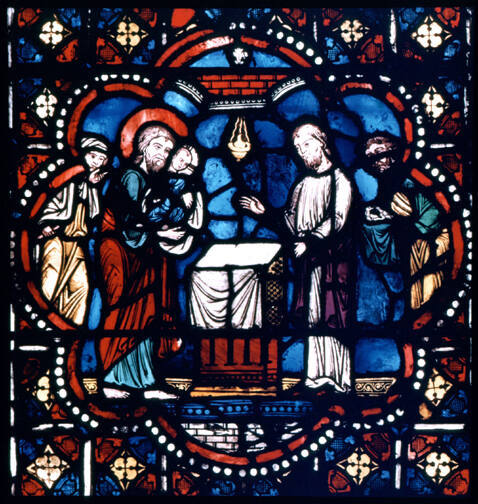
DescriptionThe visual narrative that art historians typically identify as the Presentation in the Temple represents a combination of two events prescribed by Judaic law, at thirty days and forty days, respectively, following birth of a son: the firstborn son’s presentation in the temple and redemption upon payment of five shekels, and the postpartum mother’s purification, following the sacrifice of two turtledoves. Luke’s confused and conflated account of Mary and Joseph’s observance of these Hebrew rituals (Luke 2:22-39) recounts their presentation of Christ at the temple in Jerusalem and their sacrificial offering of two turtledoves. There a holy man named Simeon, "inspired by the Spirit," took Christ "up in his arms and blessed God" while acknowledging the child as the source of salvation. An elderly prophetess, Anna, confirmed recognition of Christ as the redeemer.- Decorative Arts
The window comprises pieces of colored glass held together by lead strips. The finer drapery, hair, and facial details were painted onto the glass in grisaille using a blackish-brownish vitreous paint which was fired, prior to assembly. Such narrative windows in bright colors were becoming popular by the mid-twelfth century in ecclesiastical buildings in northern France. This particular window has been associated by scholars with the artists who worked on Lyon Cathedral’s chevet from 1215-26.
The window is heavily restored, with much modern glass, complicating its iconographical analysis. Clearly the original rendition of the scene has been restored with errors. Most importantly, Mary is missing. Currently we see on the left side of the table-like altar with hanging lamp above it the blessed figure of Simeon holding Christ; the woman behind him is Anna, holding a scroll of prophecy in her right hand while making a speaking gesture (her pointing finger) with her left. On the opposite side stands a figure who was possibly originally a haloed Mary, rather than a male figure; some scholars instead suggest the haloed figure at the left was originally Mary. Joseph appears at the far right, holding two turtledoves with covered hands. More typically, presentation scenes depict Simeon and Anna to our right and Mary and Joseph to our left, although there are rare examples of the current arrangement. Interestingly, several publications reproducing this window mistakenly reverse The Hyde image, in the belief the photo was printed backwards; thus they move the figure of Simeon to the viewers’ right, as would much more commonly be found. However examination of the window’s leading, which probably dates from the 1903 restoration by Félix Gaudin, confirms the “reversed” orientation of the scene, as currently restored.
Above text by Penny Howell Jolly, Professor Emerita of Art History, Skidmore College, February 2026
—
Octafoil central scene. Figures flanking a central table or altar, a hanging lamp suspended above it. The left hand figure with a nimbus, probably representing a saint, holding a child.
Text from 2011Exhibition HistoryEverson Museum of Art, "Medieval Art in Upstate New York", Syracuse, 1974.ProvenanceParis, Charnoz Collection, early 1920's (according to Kraus);
New York, Brummer Gallery, Inc., from whom Mrs. Hyde purchased in 1928;
Glens Falls, NY, Collection of Mrs. Louis Hyde, 1928;
By bequest to The Hyde Collection, 1952.