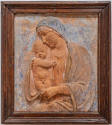
Madonna and Child
ArtistAttributed to
Giacomo Cozzarelli
Italian, 1453 - 1515
Date1475 - 1500
Place of OriginItaly
MediumTerracotta (earthenware), paint
DimensionsOverall: 22 x 19 x 3 1/8 in. (55.9 x 48.3 x 7.9 cm)
Frame Dimensions: 27 x 24 1/2 x 3 1/8 in. (68.6 x 62.2 x 7.9 cm)
Frame Dimensions: 27 x 24 1/2 x 3 1/8 in. (68.6 x 62.2 x 7.9 cm)
ClassificationsSculpture
Credit LineBequest of Charlotte Pruyn Hyde
Object number1971.88
On View
On viewCollections
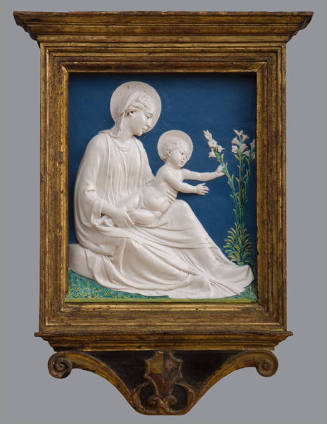
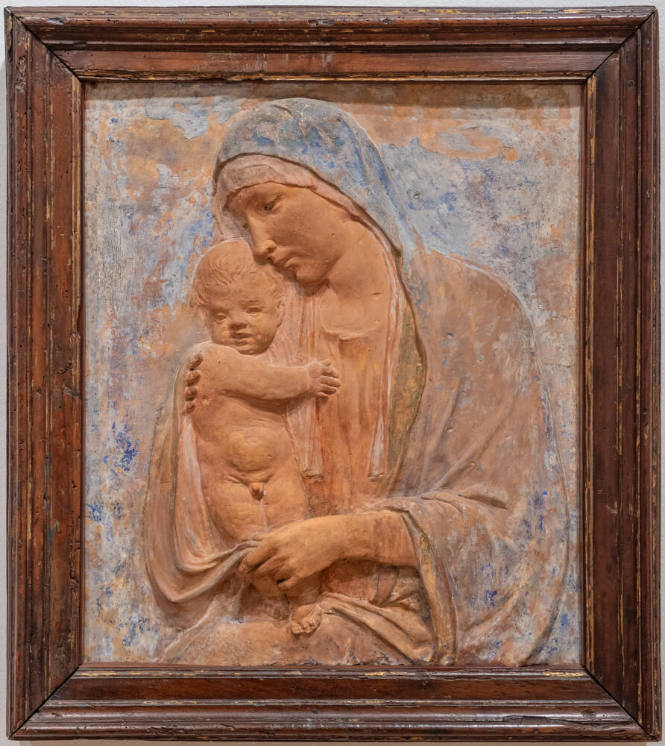
DescriptionA somber Mary here presses Christ against her cheek and breast, and loosely wraps his body in her drapery. Even so, she reveals or perhaps even presents his nude body to the viewer’s gaze. In doing so, she emphasizes that her son is fully human, in every way, and reminds viewers that his blood will be shed at the Crucifixion, the event that confirms his full human vulnerability. - Sculpture
- European Paintings & Sculpture
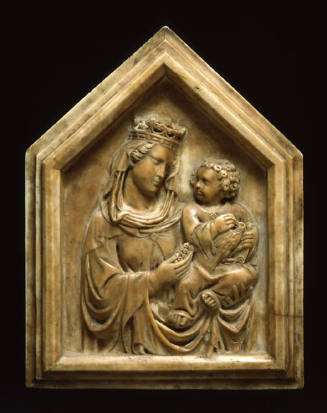
Typically displayed in bedrooms, reliefs depicting Mary with the naked Christ, like their painted counterparts, were highly popular in Renaissance Italy for their power to shape women’s volatile imaginations. It was believed that women during pregnancy were at their most vulnerable to outside influences, and images were particularly potent. A pregnant woman could gaze on this relief to help her develop a perfect male child, the generally preferred sex. Young boys, also with vulnerable imaginations, were urged by writers such as Giovanni Dominici ("On the Education of Children," ca. 1405) to look on images of the ideal Christ child and thus be impressed by his virtues.
Most families could afford images of this ideal mother and son because they were produced in a variety of media. Besides ordering expensive paintings at significant cost, elite families commissioned unique marble or bronze reliefs; less wealthy households purchased clay, stucco, or terracotta reliefs, typically mass-produced from molds. Even poor families could own inexpensive prints.
Choice of material reflected not just cost. Brightly painted, tactile reliefs could be handled by women and children, who were believed weaker than men mentally and spiritually; the bright colors enticed and engaged them. Reliefs could be further empowered by attaching coral necklaces—apotropaic protectors, especially associated with infants—or other amulets. X-rays of some Renaissance terracotta sculptures even reveal talismanic charms embedded in the clay.
Paint remnants visible here clarify this relief was originally painted. Mary wears her typical blue outer robe, and the background appears to have been painted blue, perhaps emulating a much more expensive type of relief: glazed terracottas, such as were produced by Luca della Robbia and his shop (see 1971.99). The frame is from the sixteenth century.
Text by Penny Howell Jolly, Professor Emerita of Art History, Skidmore College, February 2026Exhibition History"Objects of Devotion," Hoopes Gallery, The Hyde Collection, Nov. 30, 2003 - Feb. 29, 2004.
"Family Pride: The Italian Renaissance House and its Furnishing", The Hyde Collection, Glens Falls, NY, April 12-May 20,1984.
"Growing Up in a Renaissance Palazzo: Childhood in Italy 1400-1600," Charles R. Wood Gallery, The Hyde Collection, Oct. 5, 2024-Jan. 5, 2025.Provenancebefore 1932, Glens Falls, NY, Mr. and Mrs. Louis F. Hyde
1963, Glens Falls, NY, The Hyde Collection Trust (Bequest of Charlotte P. Hyde)