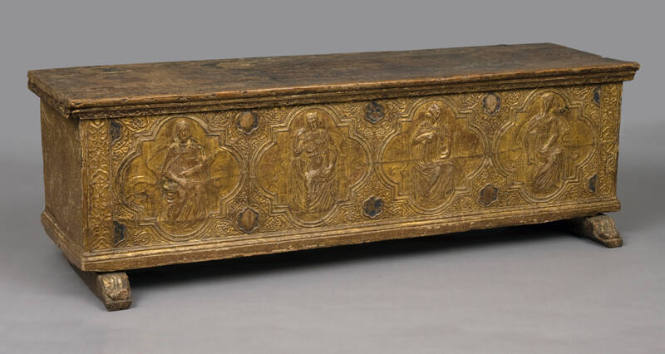
Cassone
Artist
Unknown
Date1450-1500
Place of OriginTuscany, Italy
MediumHardwood, gesso, gilding, paint
DimensionsOverall: 20 x 62 1/4 x 20 1/2 in. (50.8 x 158.1 x 52.1 cm)
ClassificationsFurniture
Credit LineBequest of Charlotte Pruyn Hyde
Object number1971.209
On View
On viewCollections
- Decorative Arts
MarkingsRemnants of paper letter with Italian inked calligraphy on underside of top.
DescriptionCassoni (singular cassone) were chests used for storing personal items, such as clothing and linens, since domestic dwellings generally lacked what we today call closets. At the time of marriage, the groom’s father commonly provided a pair of matched chests for the groom and bride. Typically painted and/or decorated with pastiglia reliefs, cassoni displayed images on the exterior and sometimes the interior, meant as lessons for the young couple and their future children. Popular heroes were taken from the Bible, like the young David or Queen Esther, but also from classical history and myths, like the story of Lucretia or tales of Aeneas. Following the marital ceremony, the bride would move into the groom’s family’s household. With her personal possessions packed in such a chest, she would participate in a public processional, her cassone on display for all to see. Family coats-of-arms were often included on the exterior. This cassone is rectangular with a hinged top, raised on four foliate-carved trestle feet. Gilded reliefs cover the surface, with remnants of paint found on the ten full or partial rosettes arranged across the front. Clearly some of these originally presented a shield-shaped form displaying now illegible family heraldry. Between those rosettes, large quatrefoils enclose four enthroned female allegorical figures representing the four Cardinal Virtues, identifiable via their attributes: from left to right, Prudence (with a book), Justice (with a sword, balance, and scales), Temperance (with water and wine in two jugs), and Fortitude (with a broken column). The chest’s missing pendant may well have depicted the three Theological Virtues (Faith, Hope, and Charity). The interior lacks paint and the back remains plain; clearly it was placed against a wall.
Text by Penny Howell Jolly, Professor Emerita of Art History, Skidmore College, February 2026
//
Rectangular with hinged top. The case is relief-decorated at the front with four quatrefoils enclosing seated allegorical figures of the four virtues each holding an attribute within a vinework surround. Six hexafoil blue-ground armorials, the relief decoration on the sides in rondels, foliate-carved trestle supports/feet. The allegorical figures are the four cardinal virtues: left to right are Prudence, Justice, Temperance, and Fortitude.
Text from 2013Exhibition History"Family Pride: The Italian Renaissance House and its Furnishings", The Hyde Collection, April 12 - May 20, 1984.
"Growing Up in a Renaissance Palazzo: Childhood in Italy 1400-1600," Charles R. Wood Gallery, The Hyde Collection, Oct. 5, 2024-Jan. 5, 2025.ProvenanceCollection of Mr. and Mrs. Louis F. Hyde, Glens Falls, NY; by bequest to The Hyde Collection, 1952.


ca. 1780