St. Peter Enthroned
Artist
Unknown
Dateca. 1475-1500
Place of OriginFrance (possibly)
Place of OriginPortugal (possibly)
Place of OriginSpain (possibly)
MediumOil on panel
DimensionsPanel: 12 1/4 × 8 1/2 in. (31.1 × 21.6 cm)
Frame Dimensions: 18 3/8 × 14 × 2 1/2 in. (46.7 × 35.6 × 6.4 cm)
Frame Dimensions: 18 3/8 × 14 × 2 1/2 in. (46.7 × 35.6 × 6.4 cm)
ClassificationsPaintings
Credit LineThe Hyde Collection Trust, 1952
Object number1971.6
On View
On viewCollections
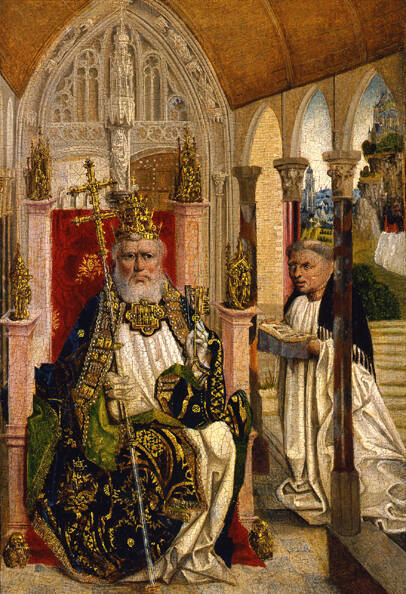
DescriptionSt. Peter sits enthroned within an elaborate gothic setting, with a cross-topped staff in his right hand and the keys to heaven, his most common identifying attribute, in his left. On his head appears a triple-tiered crown, a reference to his traditional identification as the first Bishop of Rome, i.e., the first Pope, and he wears an elaborately jeweled ecclesiastical cope, closed by a morse with three standing figures depicted on it and four large pearls. Gilded statues on his throne depict the Creations of Adam (above left) and of Eve (above right), and their Temptation (below left) and Expulsion (below right). This theme of human sin is continued by the two monstrous figures crouched on the floor under the throne. Weighed down by Adam and Eve’s sin on the pedestals directly above them, they, too, are fallen. Only three of the eight niches in the archivolt above and behind Peter include the sculptures typically found in them, leaving viewers wondering which saints would fill the remaining five. The saint at the lower right is Andrew with his X-shaped cross; the saint at the left may be James, with his pilgrim’s hat and walking stick. The upper right saint, however, remains unidentifiable. On the trumeau between two arched doorways stands a sculpture of Mary holding Jesus. - European Paintings & Sculpture
Columned arcades to the right and left—the latter barely visible—support a vaulted ceiling. A kneeling cleric under the arcade to the right holds a book and prays to Peter, while an unidentified elderly saint with white hair and beard, wearing red and dark blue, kneels and prays in the craggy landscape at the far right edge. An elaborate structure appears at the top of the rocky hill behind him, and a landscape with a high tower and surrounding smaller structures spreads out in the distance. While the artist has attempted to use one-point perspective, and has done so with some success, the depicted space is inconsistent in several areas. For example, note the inconsistent location of the column near the cleric’s right shoulder.
The tiny size of this work suggests it served as a private devotional object for the unidentified cleric kneeling at the right. Besides his posture, his humility is suggested by his location just outside St. Peter’s space; his presence at Peter’s left (the picture’s left, or sinister, side); and the cleric’s closeness to the throne’s small sculpture of Adam and Eve’s Expulsion. Located near to the cleric’s face and prayer book, the first sinners leave Eden—here, St. Peter’s holy space—and enter the cleric’s earthly realm.
Text by Penny Howell Jolly, Professor Emerita of Art History, Skidmore College, February 2026Exhibition HistoryDusseldorf Art Exhibition, 1904, no. 139.
Fogg Museum of Art, Cambridge, MA, Nov.26- Dec. 17, 1941.
"Objects of Devotion", Hoopes Gallery, The Hyde Collection, Nov. 30, 2003- Feb. 29, 2004.ProvenanceWorms, Germany, The Stein Collection
Darmstadt, Germany, Baron Max Von Heyl
1930, Munich, Germany, Helbring (auctioneer)
by 1934, Glens Falls, NY, Mr. and Mrs. Louis Hyde
1952, Glens Falls, NY, The Hyde Collection Trust



![Zanobi di Benedetto Strozzi (Italian [Florentine], 1412 - 1468), Sts. Nicholas, Lawrence and Jo…](/internal/media/dispatcher/115/thumbnail)


![Jesus Teaches in the Temple (plate 54 of the first edition of "Evangelicae Historiae Imagines, Adnotationes et Meditationes in Evangelia" [Illustrations of the Gospel Stories, Notes and Meditations on the Gospels])](/internal/media/dispatcher/1458/thumbnail)
Jean-Honoré Fragonard
1761-1764