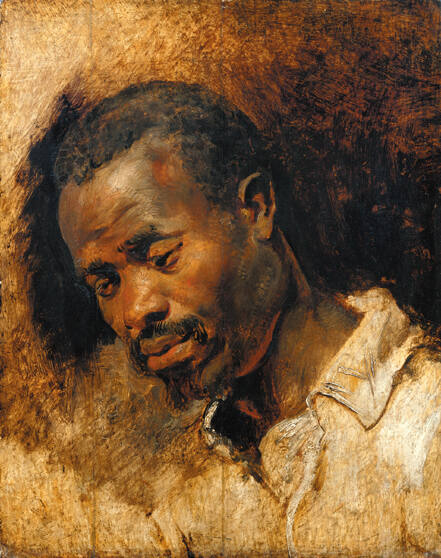
Head of a Moor
Artist
Peter Paul Rubens
Flemish, 1577 - 1640
Dateca. 1615
Place of OriginAntwerp, Flanders, Belgium
MediumOil on panel
DimensionsPanel: 18 × 14 1/2 in. (45.7 × 1.3 cm)
Frame Dimensions: 29 3/4 × 26 1/2 in. (75.6 × 67.3 cm)
Frame Dimensions: 29 3/4 × 26 1/2 in. (75.6 × 67.3 cm)
ClassificationsPaintings
Credit LineThe Hyde Collection Trust, 1952
Object number1971.40
On View
Not on viewCollections
DescriptionRubens’s "Head of a Moor," painted in a quick, painterly manner with the free brushstrokes characteristic of his modelli (studies), depicts a Black man’s head and shoulders in a three-quarter view. His flesh is beautifully toned in shades of brown and is seen in front of a neutral background, also in shades of brown. His face is bearded and moustached, and his eyes downcast with his head leaning downwards. He wears a white chemise, open at the collar.- European Paintings & Sculpture
This modello, painted from life ("naar het leven"), was likely a preliminary sketch for a more elaborate composition, although no extant image in Rubens’s oeuvre repeats this exact head. However, another oil sketch by Rubens in Brussels (Royal Museum), "Four Studies of the Head of a Black Man," makes use of the same sitter. The four views of the sitter’s head show him in different poses and different moods, and like The Hyde painting, result from Rubens’s remarkable powers of observation regarding the variety of flesh tones. Even though The Hyde Moor is depicted only bust-length, his posture suggests a full-length figure lowering his head and eyes in the presence of something greater than he. This supports the likelihood the figure was to serve as one of the three magi in a scene of the Adoration of the Magi.
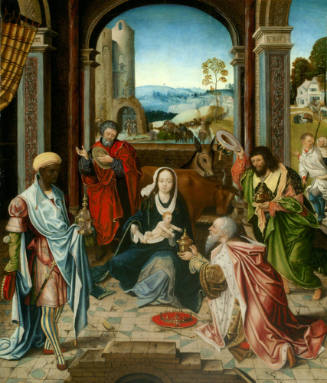
The tradition of depicting one of the magi as a Black man, although not specified in the Bible, had arisen in northern Europe in the fourteenth century and became well established in the fifteenth. The three magi, sometimes called kings or wise men, were understood to represent the three known continents—Europe, Asia, and Africa—bringing gifts and coming to adore the holy child. Matthew’s Gospel text (2.1-12) simply refers to them as magi from the East, specifying neither their number, nor their race, nor their names. Likely because Matthew tells of their offering of three gifts, later authors assumed three individuals brought them.
The painting’s condition is excellent, with no signs of later retouching. Its attribution to Rubens is almost universally accepted, although Erik Larsen and Walter Liedtke both identify it as by Anthony van Dyck. Writing in the "Corpus Rubenianum," Nico van Hout, however, maintains the attribution to Rubens and sees "no compelling reasons" to assign it to van Dyck.
When Charlotte Hyde purchased this painting in 1938, it was called "Head of a Negro." Artists working in the Early Modern period, such as Rubens, rarely assigned titles to their paintings. The title "Head of a Negro" was likely given to the work by an art dealer in the early twentieth century. In 2004, The Hyde Collection retitled the work as "Head of a Moor," using a term that was more period-appropriate for Rubens’s lifetime.
Text by Penny Howell Jolly, Professor Emerita of Art History, Skidmore College, February 2026Exhibition History"Masterpieces of Art," New York World's Fair, 1939;
The Fogg Art Museum of Harvard University, Cambridge, MA, Oct. 1941;
"Masterpieces of Five Centuries," Van Diemen-Lilienfeld Galleries, NY, Jan. 20 - Feb. 3, 1951;
"Drawings & Oil Sketches by P.P. Rubens from American Collections," Fogg Art Museum, Cambridge, MA, Jan. 14 - Feb. 29, 1956; The Morgan Library, NY, Mar. 20- Apr. 28, 1956;
"Drawn by the Brush: Oil Sketches by Peter Paul Rubens," Bruce Museum of Arts and Science, Greenwich, CT, Oct. 2, 2004- Jan. 30, 2005; University of California, Berkeley Art Museum and Pacific Film Archive, Berkeley, CA, Mar. 2-May 15, 2005; and Cincinnati Art Museum, Cincinnati, OH, June 11-Sept. 11, 2005.ProvenanceCzechoslovakia, Count Schwanenberg
by 1938, New York, NY, Lilienfeld Galleries
1938, Glens, Falls, NY, Mrs. Charlotte P. Hyde
1952, Glens Falls, NY, The Hyde Collection Trust


![Zanobi di Benedetto Strozzi (Italian [Florentine], 1412 - 1468), Sts. Nicholas, Lawrence and Jo…](/internal/media/dispatcher/115/thumbnail)