Portrait of a Lady
Artist
Bartholomaeus (Barthel/Bartel) Bruyn, the Elder
German, 1493 - 1555
Dateca. 1535
Place of OriginGermany
MediumOil on panel
DimensionsPanel: 12 × 9 in. (30.5 × 22.9 cm)
Frame Dimensions: 23 1/2 × 29 in. (59.7 × 73.7 cm)
Frame Dimensions: 23 1/2 × 29 in. (59.7 × 73.7 cm)
ClassificationsPaintings
Credit LineThe Hyde Collection Trust, 1952
Object number1971.11
On View
On viewCollections
- European Paintings & Sculpture
Signedunsigned (Bruyn is not known to have signed his work, it is identified through documented commissions)
MarkingsOn reverse, two small round stickers "E471"; "Frame E471".
Two old labels: "To take picture out undo screws where marked" (removed and placed in file)
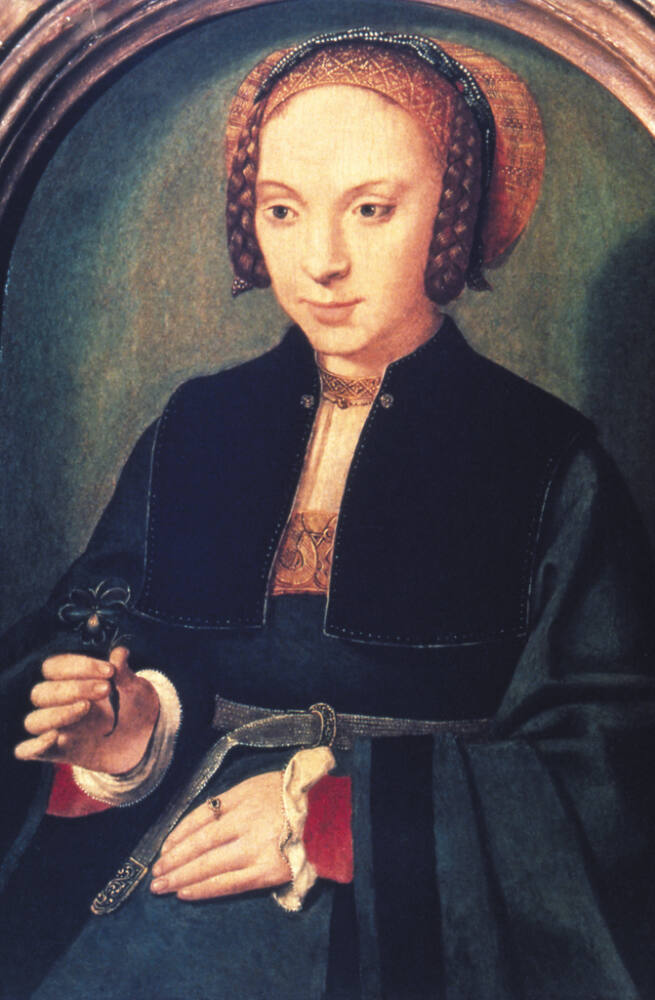
DescriptionBartholomaeus Bruyn, the Elder, lived and worked in Renaissance Cologne, where he was the leading portrait painter of the first half of the sixteenth century; his clientele were largely upper-middle-class, urban patrons. We see such an unidentified woman here in what is likely one panel of a diptych with her future husband on the opposite side, turned three-quarters view toward her. Bruyn painted numerous such diptychs using a similar formula of half-length man to the viewer’s left, half-length woman to the viewer’s right. This widespread Renaissance convention, found in altarpieces as well as smaller works, puts the male to the more positive right side (from the perspective of the diptych) and the female to the diptych’s lesser left side. The young woman’s eyes are modestly downcast, an appropriately diffident posture, and she is depicted against a flat green background marked only by cast shadows: her own and that of the frame which encloses her.Several elements suggest the original diptych was commissioned on the occasion of the young couple’s betrothal. By law, married women wore their braided hair completely covered by a cap, but betrothed women displayed modestly braided hair during the engagement period, as seen here. Orderly hair on women more generally symbolized moderation and moral control, highly desired qualities in young women. In addition, the young woman holds bittersweet nightshade, a flower traditionally an attribute in Cologne of couples during their period of betrothal, prior to marriage.
Above text by Penny Howell Jolly, Professor Emerita of Art History, Skidmore College, February 2026
—
Portrait of a young female in slightly more than 1/2 length view on a green ground. The figure is turned somewhat to her right. She holds up a blue flower (probably a columbine, symbol of fidelity and the Holy Spirit) between the thumb and forefinger of her right hand. She wears a ring on the forefinger of her left hand which rests on the front of her dress. Her dress and/or robe garment is two shades of blue, the darker in the large squared "collar" that looks like a short-waisted jacket, and echoed in a broad band on the lower section of the long outer sleeves which have a wide opening. There is a gold colored (and enamel?) trefoil-shaped button at either side of the collar. A tighter, red sleeved garment is worn under the blue sleeves. These are trimmed with a white ruffle edged with what appears to be silk loop stitching or possibly narrow lace that catches the light. A wide band of gold-colored trim having an interlocking scroll pattern appears at the top of the bodice and a narrower lattice pattern trim in gold ornaments the neck. There appears to be a sheer material connecting the two. A belt with bright highlights is worn slightly below the bustline. She wears an elaborate headpiece with a broad, patterned gold headband. Her hair is braided and worn in pendant loops in front of, or just over, her ears, which are not visible. Behind the headband is a darker band with bright highlights, probably pearls, and the remainder of her hoop shaped cap.
The panel has a rounded arched top and conforming molded, gilt frame. This is housed in a later mahogany frame with a brown velvet inner liner.
Text from 2012Provenanceby 1929, New York, NY, E. A. Milch , Inc.
1929, Glens Falls, NY, Mr. and Mrs. Louis F. Hyde
1952, Glens Falls, NY, The Hyde Collection Trust

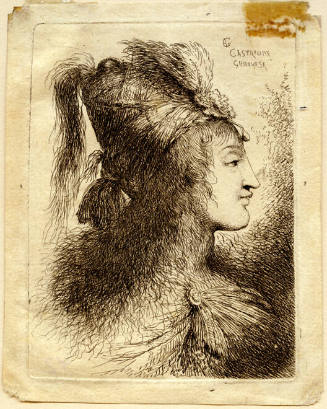
Giovanni Benedetto Castiglione
ca. 1645-50