
Assumption of the Virgin Mary
Artist
Pellegrino di Mariano
Italian, born 1442
Dateca. 1475
Place of OriginSiena, Italy
MediumTempera and gold leaf on panel
DimensionsPanel: 10 3/4 × 7 1/2 in. (27.3 × 19.1 cm)
Frame Dimensions: 13 1/8 × 9 1/2 in. (33.3 × 24.1 cm)
Frame Dimensions: 13 1/8 × 9 1/2 in. (33.3 × 24.1 cm)
ClassificationsPaintings
Credit LineBequest of Charlotte Pruyn Hyde
Object number1971.19
On View
On viewCollections
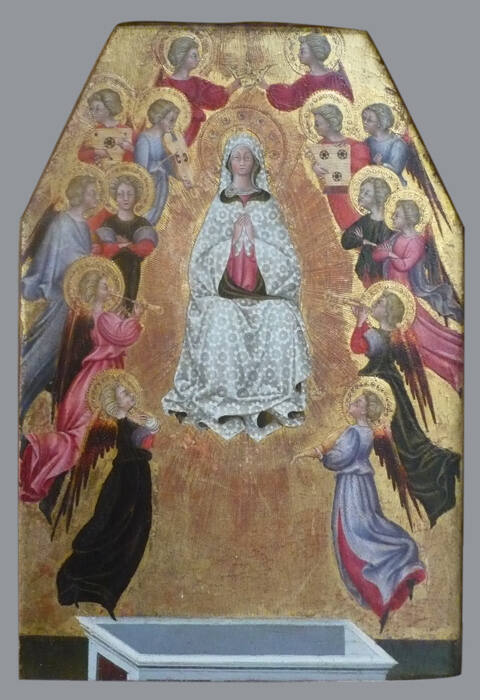
DescriptionA seated, praying Virgin Mary, dressed in red covered by a patterned white mantle, is surrounded by a mandorla—a full-body halo—while fourteen angels accompany her body into heaven. Some of the angels watch, while others play musical instruments; the top-most pair elevates a crown over Mary’s head, anticipating her imminent coronation by Christ in heaven. This subject was a favorite of Sienese artists and their patrons, as the Cathedral of Siena is dedicated to the Virgin Mary of the Assumption; a large stained glass rose window, designed by Duccio ca. 1288 with a central image of the Assumption below a scene of Mary’s Coronation, originally rose above the main altar.- European Paintings & Sculpture
The doctrine of the bodily Assumption of the Virgin Mary was not officially adopted by the Catholic Church until 1950; however, already by the eleventh century, artists were depicting the holy event. Jacopo da Voragine, writing his influential and widely read Golden Legend about 1260, includes a lengthy entry for the Feast Day of the Assumption, August 15. There he describes how an angel came to Mary bearing a "branch of the palm of Paradise" and alerted her to her coming death. Her request that the apostles come to her first was fulfilled—they flew in on clouds—and Christ himself came and took her soul to heaven. Three days later, he returned with a multitude of angels, and Mary was bodily assumed into heaven, as seen here. Her sarcophagus lies empty below, although more commonly fifteenth-century images of the Assumption show it filled with roses and surrounded by the Apostles, who examine it in amazement.
The panel was truncated at the top; likely an image of God the Father appeared there. Albert G. Hess has identified the angels’ instruments (left to right, bottom to top): cymbals, lute, double shawm, double flute, drone fiddle, half psaltery, and an instrument at top right illegible due to damage.
Little is known of Pellegrino, a Sienese artist, though he worked as both a painter and a miniaturist, and his style suggests he may have trained with Giovanni di Paolo.
Text by Penny Howell Jolly, Professor Emerita of Art History, Skidmore College, February 2026Exhibition History"Objects of Devotion." Hoopes Gallery, The Hyde Collection, Glens Falls, Nov. 30, 2003- Feb. 29, 2004.ProvenanceBerlin, German, Paul Bottenweiser (dealer)
August Berg
by 1950, New York, NY, Mortimer Brandt Galleries
1950, Glens Falls, NY, Mrs. Charlotte P. Hyde
1963, Glens Falls, NY, The Hyde Collection Trust (Bequest of Mrs. Charlotte P. Hyde)





![Zanobi di Benedetto Strozzi (Italian [Florentine], 1412 - 1468), Sts. Nicholas, Lawrence and Jo…](/internal/media/dispatcher/115/thumbnail)
