
Casket
Artist
Workshop of Moral and Love Themes
Italian, 1500 - 1540
Dateca. 1510
Place of OriginItaly
MediumWood, pastiglia (lead oxide molding compound), red bole, gilding, silk (lining)
DimensionsOverall: 4 13/16 x 7 7/8 x 4 3/4 in. (12.2 x 20 x 12.1 cm)
ClassificationsWoodenware
Credit LineBequest of Charlotte Pruyn Hyde
Object number1971.167
On View
On viewCollections
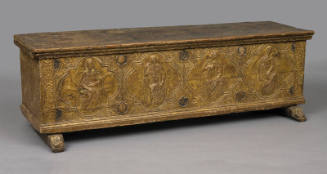
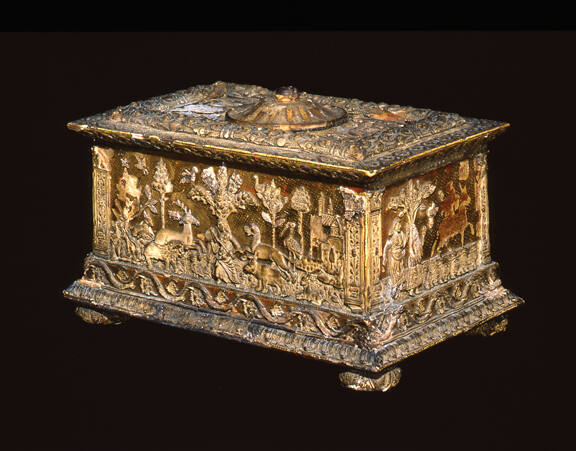
DescriptionAlthough art historians commonly identify these pastiglia caskets as jewelry boxes, Patrick M. de Winter notes that Renaissance families would have secured expensive jewelry in metal strongboxes. More likely this decorative casket, a bride’s traditional engagement or wedding present, stored a woman’s trinkets and small personal belongings. Probably made in Venice or Ferrara, this box with a hinged top shows influence from classicizing Renaissance architecture, including rinceaux and palmetto designs, rosettes, and corner pilasters. Four reliefs on its sides, all taken from popular classical authors, offer lessons for the household focused on love and marriage. - Decorative Arts
On the front, the story of Diana and Actaeon from Ovid’s "Metamorphoses" advocates the importance of female chastity. Diana, virgin goddess of the hunt, guarded her chastity diligently. When the hunter Actaeon inadvertently spied on her and her nymphs bathing, the goddess turned him into a stag his own hounds then slaughtered. Oddly, although Diana remained unmarried, women in the ancient Roman world prayed to her for successful conceptions and easy childbirth, certainly concerns of Renaissance brides.
The two end reliefs, the "Rape of Europa" and "Rape of Deianira," also offer lessons for the bride-to-be, again highlighting the importance of chastity, yet simultaneously reminding her of her future marital duties. Europa was abducted by Jupiter in the form of a bull, but according to Horace’s first-century BCE "Odes" (book three, poem 27), she was urged to accept her suitor. Indeed, she bore him three sons, including Minos, future king of Crete. Her fate parallels that of Renaissance brides, who leave their natal families and become part of their husband’s, with a main duty to bear children. Hercules rescued his wife Deianira—whose name means "man-destroyer"—from the centaur Nessus, yet Nessus tricked her into inadvertently killing Hercules by giving him a poisoned shirt. A virtuous wife, she is horrified at her act and commits suicide.
"Orpheus Serenading the Animals," on the back side, seems an unusual choice for a bride. Although Orpheus heroically tried to rescue his wife Eurydice from the Underworld, he failed. But perhaps his music playing, shown here, brings harmony into the household, as it was believed able to temper even young boys’ libidinous natures.
Above text by Penny Howell Jolly, Professor Emerita of Art History, Skidmore College, February 2026
—
Northern Italian Renaissance pastiglia casket probably from Venice or Ferrara. Having a rectangular-hinged top with applied rosette, grotesque masks and vinework within husk border. The sides with panels depicting: back Orpheus playing to the animals; sides - The Rape of Deianeira and The Rape of Europa; front - Diana and Acteon. Metal lock push button and red fabric lined interior.
Text from 2010Exhibition History"Opening Pandora's Box: A Selection of Boxes from the Permanent Collection." Birdsall gallery, May 11- Dec. 3, 2000
"Family Pride: The Italian Renaissance House and its Furnishings," The Hyde Collection, April 12-May 20, 1984, ill. and text on pg 24, checklist of exhibtion, no 14, pg. 42
"Growing Up in a Renaissance Palazzo: Childhood in Italy 1400-1600," Charles R. Wood Gallery, The Hyde Collection, Oct. 5, 2024-Jan. 5, 2025.