

St. Augustine Holding the Trinity
Artist
Unknown
Dateca. 1350
Place of OriginGermany
Mediumalabaster with traces of polychromy
DimensionsOverall: 19 7/8 x 13 3/4 x 9 1/4 in. (50.5 x 34.9 x 23.5 cm)
ClassificationsSculpture
Credit LineBequest of Charlotte Pruyn Hyde
Object number1971.87
On View
On viewCollections
DescriptionSt. Augustine (354-430 CE), one of the Latin Church fathers, served as bishop of Hippo, in modern Algeria, and produced some of Christianity’s most influential theological writings. He is here identified by his bishop’s miter and ecclesiastical vestments, as well as by an open book. The latter signifies not only his multiple foundational writings, but may refer to his conversion. As he reports in his "Confessions," a voice told him, "take up and read." The small sculpture of the Trinity in his right hand, a type known as the Throne of Mercy, where an enthroned God the father supports the dead body of Christ and the dove of the Holy Spirit flies between them, recalls his treatise "On the Trinity," while the heart at the base of Christ’s cross expresses great love for God and God’s love for humankind.- Sculpture
- European Paintings & Sculpture
The back of the sculpture is flat, suggesting an original location against a flat surface, possibly as part of an altarpiece. Alabaster is a material most commonly used in England, and some scholars have assigned this "Augustine" to an English sculptor, but stylistic arguments suggest a German origin. Traces of polychromy (paint) can be found on the alabaster.
Text by Penny Howell Jolly, Professor Emerita of Art History, Skidmore College, February 2026Exhibition History"Objects of Devotion," Hoopes Galllery, The Hyde Collection, Nov. 30, 2003- Feb. 29, 2004.Provenancebefore 1919, New York, NY, Karl Freund (dealer)
1919, Glens Falls, NY, Mr. and Mrs. Louis F. Hyde
1963, Glens Falls, NY, The Hyde Collection Trust (Bequest of Mrs. Charlotte P. Hyde)

![Zanobi di Benedetto Strozzi (Italian [Florentine], 1412 - 1468), Sts. Nicholas, Lawrence and Jo…](/internal/media/dispatcher/115/thumbnail)


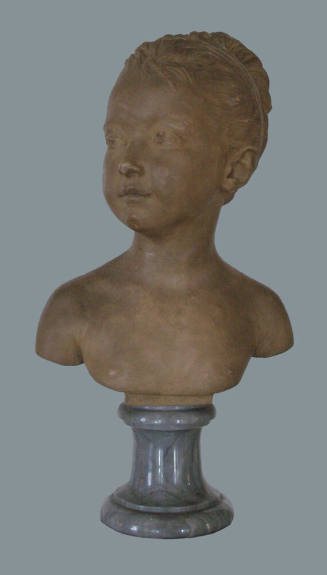
Jean-Antoine Houdon (reproduction)