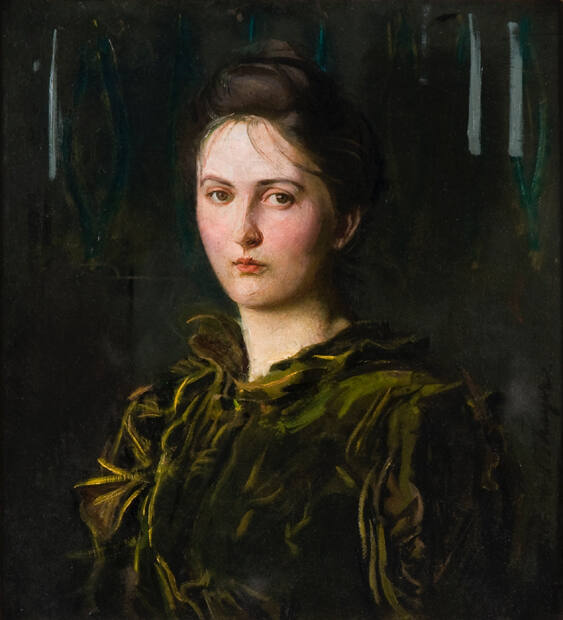
Mary: Portrait of the Artist's Daughter
Artist
Abbott Handerson Thayer
American, 1849 - 1921
Designer
Stanford White
American, 1853 - 1906
Date1894 (reworked 1902)
Place of OriginUnited States of America
MediumOil on canvas
DimensionsStretcher: 24 × 22 1/16 in. (61 × 56 cm)
Frame Dimensions: 38 × 39 3/4 × 5 1/4 in. (96.5 × 101 × 13.3 cm)
Frame Dimensions: 38 × 39 3/4 × 5 1/4 in. (96.5 × 101 × 13.3 cm)
ClassificationsPaintings
Credit LineBequest of Charlotte Pruyn Hyde
Object number1971.46
On View
On viewCollections
- American Paintings & Sculpture
SignedSigned LR: " Abbott Thayer."
Markings1013.90 previous acc. # on frame & stretcher.
DescriptionAbbot Handerson Thayer’s bust-length portrait of his eighteen-year old daughter Mary reveals a serious young woman, her hair slightly tousled, wearing a loose-fitting dark green, collared dress. Her gaze directly confronts viewers, as she turns her head outwards towards us, breaking from her otherwise three-quarter pose. Three blue-grey stripes in the upper background help create a sense of space within the otherwise undefined, dark setting. Thayer worked from live models and not only produced multiple portraits of his children, but used them as prototypes for allegorical figures in his paintings.At the opening of the twentieth century, Thayer was among the most prominent of living American artists. Born in Boston and raised in Keene, New Hampshire, Thayer lived and studied both in New York City and in Paris; in the latter, he worked with the academic painter Jean Léon Gérôme. However, his search for “unsullied purity; spiritual truth” (Thayer, as quoted in Maryman) led him to return to Keene. A Transcendentalist and devoted naturalist, his animal and bird studies reflected his lifelong interest in what he called “protective coloration,” a theory renamed “camouflage” by the French and put to use by both France and Germany in World War I. Unfortunately, Franklin D. Roosevelt, Assistant Secretary of the Navy, remained unconvinced of the usefulness of such protective patterns. But it was Thayer who introduced the still-used dazzle pattern. Best known for his landscapes in his own day, today he is better known for his portraits and his allegorical figures of angel-like, winged women.
The elaborate tabernacle-like frame—a Renaissance revival style—was designed by the architect Stanford White (1853-1906) of the famed architectural firm McKim, Mead, and White.
Above text by Penny Howell Jolly, Professor Emerita of Art History, Skidmore College, July 2026
-
Frame design by Stanford White who did several designs for Thayer's work. White's designs were made by several NY firms including E. A. Milch, from whom this painting was purchased by the Hydes. Other makers include Oscar Rudolph, Wirth and Fyfe and Joseph and Alexander Cabus (successors to the cabinetmakers Kimbell and Cabus?).
Text from 2011Exhibition History"Memorial Exhibition of the Work of Abbott Handerson Thayer," The Metropolitan Museum of Art, New York, March 20-April 30, 1922.
"Abbott Handerson Thayer," Everson Museum of Art, Syracuse, New York, Sept. 17, 1982-Nov. 7, 1982; National Academy of Design, Dec. 10, 1982-jan. 23, 1983; Currier Gallery of Art, Feb. 18-April 3, 1983.
"Transcendent Universe: The Paintings of Abbott Handerson Thayer," The Hyde Collection, Glens Falls, New York, February 11-April 14, 1996.
"Stanford White and Louis Comfort Tiffany and Their Circle," Nassau County Museum of Art, Roslyn, NY, Sept. 24, 1998 - Jan. 3, 1999.
"Family Matters: American Impressionism and Realism," The Hyde Collection, Glens Falls, Apr. 27- July 27, 2003.Provenanceuntil 1921, Dublin, NH, Family of Abbott Handerson Thayer
1921, John Gellatly, (a friend of the artist and collector of his works)
New York, NY, E. & A. Milch Company, Inc.,
1922; Glens Falls, NY, Mr. and Mrs. Louis F. Hyde
1963, Glens Falls, NY, The Hyde Collection Trust (Bequest of Charlotte P. Hyde)