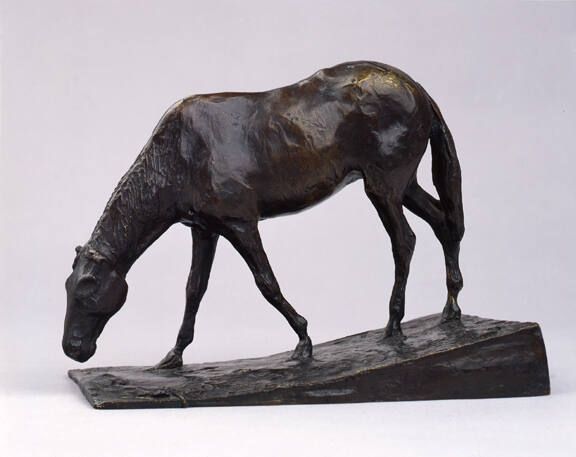
Horse at Trough
Artist
Edgar Degas
French, 1834 - 1917
Date1865-1868
Place of OriginFrance
MediumBronze
DimensionsOverall: 6 1/2 x 8 1/2 x 5 1/4 in. (16.5 x 21.6 x 13.3 cm)
ClassificationsSculpture
Credit LineBequest of Charlotte Pruyn Hyde
Object number1971.92
On View
On viewCollections
- Sculpture
- European Paintings & Sculpture
MarkingsTo right of front leg: "Degas"; stamped on pedestal left rear: "cire perdu A A Hebrard Paris B-13."
DescriptionEdgar Degas’ “Horse at Trough” depicts a horse standing on a slanting base and lowering his head into an imagined trough of food or water. Unlike Degas’ more typical small bronze sculptures of horses, this figure stands almost at rest, his relaxed tail and hanging head creating a sense of exhaustion unlike the equine energy and active poses visible in his later bronze horses. For those, Degas was influenced by Eadweard Muybridge’s 1878 publication “The Horse in Motion.” The surface treatment of The Hyde’s horse and the ground on which he stands reveals one reason why Degas is considered an Impressionist: the bronze surface reflects light in a mottled way, breaking up surfaces and reminding viewers that this figure was originally cast from a model made from malleable materials, typically wax mixed with clay, plastiline, and other materials. Degas is well known today for his drawings, paintings, and sculptures of dancers, artworks based on his viewing of performers at rehearsals, on stage, or backstage. Yet he also had a life-long interest in horse racing and horses, and observed them closely; note the carefulness with which he depicted the veins and tendons of the horse’s legs. Following his 1917 death, more than 150 small wax models of horses, dancers, and other figures were found in his studio; approximately fifteen were of horses. His heirs, determined to cast these models in bronze, over the next several years produced 23 editions (sets) of 72 of the models, labelling each with both its edition (by using the alphabet from A to T and thus recording its order of production), plus a number to identify which model of the 72 it came from. The original wax model for The Hyde’s bronze, created ca. 1866-1868 during Degas’ early career, is housed at The Virginia Museum of Fine Arts (93.56). Several other collections, e.g., The Metropolitan Museum of Art, own examples of this same bronze, cast in ca. 1920. The Hyde’s “Horse” numbers B-13 and so is from the first set cast just after Mrs. H. O. Havemeyer’s receipt of the “A” casting of the entire set.
Small bronzes, such as those placed on tables, desks, or other pieces of furniture, became popular three-hundred years earlier in the Renaissance, as humanist scholars displayed their widespread knowledge of classical, secular, and religious beings through the display of these small bronze figures. Equestrian statues, large and small, honored victors, while others told tales of Hercules and Antaeus or David triumphing over Goliath. Impressionist Degas, by contrast, focused on everyday subjects and activities.
Text by Penny Howell Jolly, Professor Emerita of Art History, Skidmore College, July 2026
Exhibition History"19th Century Annimaliers", Arnot Museum, Elmira NY, Oct. 5 - Nov. 30, 1985.
"Focus on Degas", The Hyde Collection, Jan. 9 - March 26, 1995.
"Degas and America: The Early Collectors," High Museum of Art, Feb. 3 - May 27, 2001 and the Minneapolis Institutue of Arts, June 16 - Oct. 9, 2001.
"Degas and the Art of Japan", Reading Public Museum, Reading, PA, Sept. 29 - Dec. 30, 2007.
"Degas and Music," Wood Gallery, July 12 - Oct. 18, 2009.
"Horse & Rider", Rotunda Gallery, July 20-October 3, 2018
"Degas at The Hyde: A Master of Form," Whitney-Renz Gallery, The Hyde Collection, Glens Falls, NY, October 7-Dec. 31, 2023.ProvenanceParis, France, Halvorsen (collector and dealer)
New York, NY, Feragil Galleries
1925, Glens Falls, NY, (Mrs. and Mrs. Louis F. Hyde
1963, Glens Falls, NY, The Hyde Collection Trust (Bequest of Charlotte P. Hyde)